
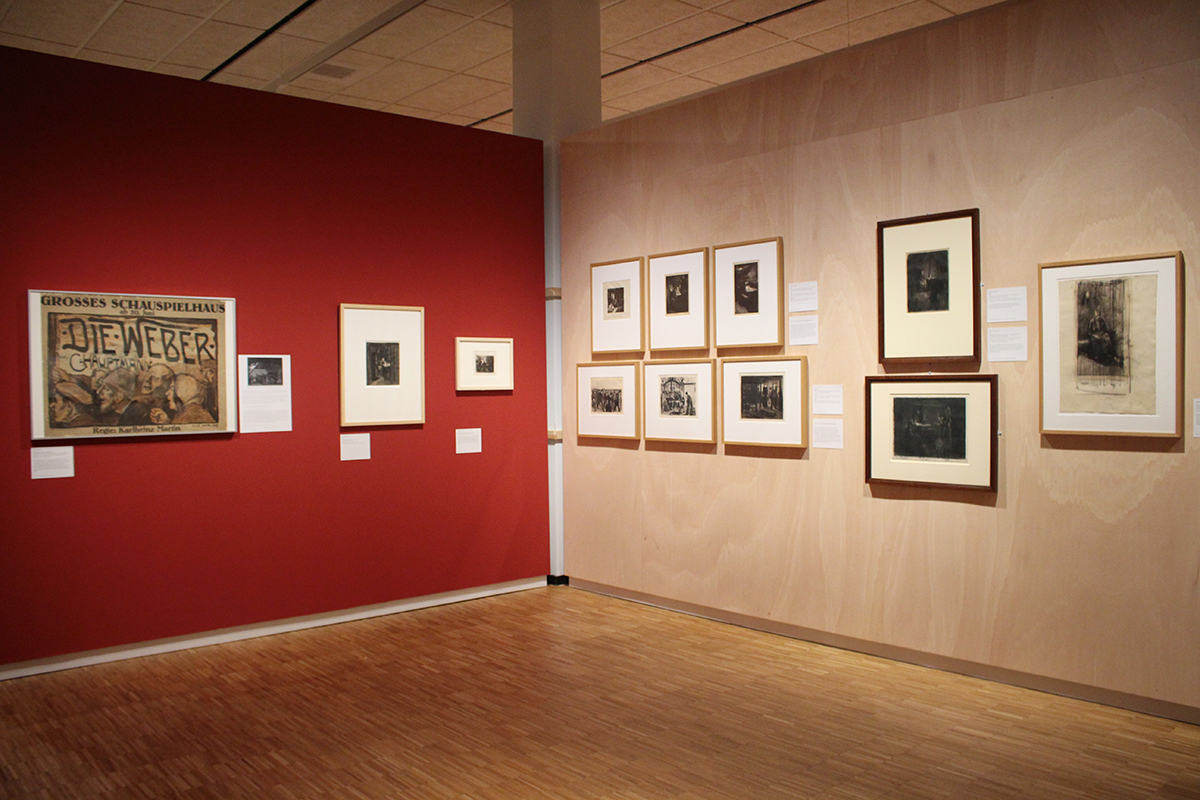
By the end of her studies in Munich in 1889, the young Käthe Schmidt had already begun an artistic adaptation of Émile Zola’s (1840–1902) novel “Germinal”. At the same time, she was also exploring the character of Gretchen from Johann Wolfgang von Goethe’s (1749–1832) “Faust I”.
After her marriage to Karl Kollwitz (1863–1940) in 1891, she continued to work on both themes in Berlin. The premieres of Gerhart Hauptmann’s (1862–1946) drama “Die Weber” (The Weavers) on February 26, 1893, and Max Halbe’s (1865–1944) “Jugend” (Youth) on April 23, 1893, introduced further motifs into her work. She was particularly struck by the successful production of “The Weavers”, which led her to create her own cycle on this subject by 1897. The presentation of this cycle at the Great Berlin Art Exhibition in 1898 marked her artistic breakthrough. Emperor Wilhelm II’s refusal to award the series was countered by widespread recognition from experts and the public.
exhibited works:
18
Eugène Delacroix
Gretchen at the Spinning Wheel / Marguerite au rouet
Illustration for Goethe’s “Faust I”
1828
Lithograph
Staatliche Museen zu Berlin, Kupferstichkabinett
Gretchen has fallen in love with Faust after he courted her intensely and they kissed for the first time. But she senses that this love will not end happily. So she talks to herself in her room, a monologue that was also set to music by Franz Schubert (1797–1828) in 1814.
The refrain goes:
My peace is gone
my heart is heavy
I find, I find it no more
19
Peter von Cornelius (design)
Ferdinand Ruscheweyh (execution)
Gretchen: “Oh, you who suffer so much, turn your gracious face toward my distress!”
Illustration for Goethe’s “Faust I,” sheet 9, 1816
Etching (F)
Berlin State Museums, Kupferstichkabinett
After Faust seduces the young girl, she finds herself expecting an illegitimate child. At that time, this meant social ruin for a woman. So Gretchen begs the Virgin Mary, in the form of Mater Dolorosa (Mother of Sorrows), for mercy.
20
Josef Hegenbarth
Kennel
Sheet 5 of 6 lithographs for “Faust. Part I”
1922
Lithograph
Private collection, Berlin
21
Käthe Kollwitz
Woman’s Fate (Martyrdom of Woman)
circa 1889
Wash pen and brush drawing on handmade paper
Käthe Kollwitz Museum Cologne
The sheet was probably created in 1889 during Kollwitz’s studies in Munich. It shows a half-naked woman crouching in front of an older woman and reaching imploringly for her arm. The older woman, dressed in a dark robe, leans forward as if to comfort the desperate woman. The cross in the background evokes associations with the fervent prayer with which Gretchen, pregnant out of wedlock, begs the Mater Dolorosa for mercy.
22
Käthe Kollwitz
Kneeling before an image of the Virgin Mary
circa 1893
Pen and ink, with brushwork samples in ink on the right, on sturdy vellum
Käthe Kollwitz Museum Cologne
This pen-and-ink drawing, created around 1893, shows that Käthe Kollwitz drew on various well-known illustrations of Goethe’s Faust I when she first began working on the character of Gretchen.
23
Käthe Kollwitz
Seated Woman Covering Her Face with Her Right Hand
circa 1893
Charcoal and pen in black ink on drawing paper
Private collection
While the ink drawing, probably created in Munich, only hints at the Gretchen motif, the reference to Goethe’s Faust tragedy is more evident in this drawing. It prepares the ground for the etching “An der Kirchenmauer” (At the Church Wall), in which a niche in the masonry and the long robe of a female statue can be seen above the seated woman.
24
Käthe Kollwitz
At the Church Wall
1893
Etching, line etching, drypoint, and brush etching
Käthe Kollwitz Museum Berlin
A comparison reveals that Käthe Kollwitz was inspired by existing depictions when she first began her artistic interpretation of the figure of Gretchen. While Eugène Delacroix (1798–1863) shows the girl unhappy in love, the artist uses the seated motif for the deeply despairing Gretchen, who realizes she is pregnant out of wedlock.
25
Käthe Kollwitz
Gretchen
1899
Etching, drypoint, and aquatint on Chinese paper, rolled onto copperplate paper
Staatliche Museen zu Berlin, Kupferstichkabinett
Six years after her first etching on the theme of Gretchen, the artist designed an independent version of the motif. She combines two phases of the drama’s plot on one sheet. The unhappy, pregnant Gretchen stands on a footbridge over a body of water. Below her, she sees a comforting vision of the future: there, the child she drowned in despair after giving birth is lovingly embraced by a maternal figure of death.
26
Käthe Kollwitz
Königsberg Pub
circa 1891
Pen and ink in black, gray wash on drawing paper
Käthe Kollwitz Museum Cologne
After receiving recognition from her colleagues in Munich for an illustration for Émile Zola’s (1840–1902) novel Germinal, Käthe Kollwitz continued to pursue the theme upon her return to Königsberg. During the day, she made drawings in disreputable harbor pubs for the setting of the fight scene from Germinal that she wanted to depict.
The artist clearly based her work on the principle of the peep-box stage, in which the audience looks into the setting of an event as if through a missing fourth wall.
27
Käthe Kollwitz
Two Men Wrestling
circa 1892/93
Black charcoal, smudged in places on vellum
Käthe Kollwitz Museum Cologne
After Käthe Kollwitz had familiarized herself with the setting, she carried out studies of the characters in a key scene from the novel “Germinal” that she wanted to depict. Two young men fight over Catherine, a young miner.
28
Käthe Kollwitz
Scene from Germinal
1893
Etching, line etching, drypoint, and emery
Käthe Kollwitz Museum Berlin
Before Käthe Kollwitz turned her attention to the weavers’ story for her famous first graphic cycle, “A Weavers’ Revolt,” she completed this etching based on Émile Zola’s (1840–1902) novel “Germinal.”
29
Max Liebermann
Portrait of Gerhart Hauptmann
1892
Pastel
Staatsbibliothek zu Berlin – Preußischer Kulturbesitz
Käthe Kollwitz had already met Gerhart Hauptmann (1862–1946) before she saw the premiere of his drama “Die Weber” (The Weavers) on stage in 1893. The two had probably met before she began her studies in Berlin in 1886/87. During that winter semester, the aspiring artist was presumably invited several times to the home of the then still unknown poet in Erkner near Berlin. A loose correspondence developed between the two until 1943.
On “The Weavers”
[…] The suffering weavers are the heroes; each of the characters is merely a trait of this hero, a line in his portrait. The playbill, itself an interesting document in theater history, lists fifty characters, more than any other drama in stage literature […]
The characteristic feature of the weavers’ uprising, the absence of any political element and any actual revolutionary impulse, made the portrayal clearly effective. One could sense it: here, it was not utopian dreamers who rose up to attack the existing state; here, it was only a frenzy of despair, a delirium of hunger that had caused an excess; here, one stood before people who, full of reverence for the existing order, even accepted starvation as their fate within the beloved world order and resisted only starvation itself. The intended provocative effect was as little apparent as it was intended.
Isidor Landau – Berliner Börsen-Courier 28.2.1893
On “The Weavers”
[…] But there is not a trace of actual political poetry in his work; the poet avoided all rhetoric, and everything has been created and shaped in a genuine and truthful manner. Artistically, Gerhart Hauptmann is one of the very few in our time who carry the genuine wings of poetry on their shoulders and rise above the steam and haze of party politics to dwell in those purer heights that are accessible only to poets, philosophers, and truly religious natures. What moved the visitors to the “Freie Bühne” to such stormy applause on Sunday was certainly not the revolutionary speech of a party politician, but only the general, great humanity that expressed itself strongly in love, compassion, and hatred: everything political and socialist has here been purified into the purest artistic education and humanity floating above naked interest.
Julius Hart – Tägliche Rundschau 28.2.1893
30
Lovis Corinth
Rudolf Rittner as Florian Geyer
circa 1915
Watercolor and black chalk, heightened with opaque white
Staatliche Museen zu Berlin, Kupferstichkabinett
The actor Rudolf Rittner (1869–1943) played the title role in the new production of Hauptmann’s Peasant War drama Florian Geyer at the Lessingtheater in Berlin in 1904. The stage design and costumes were by the painter Max Slevogt (1868–1932). Rittner was known to Käthe Kollwitz as Moritz Jäger from the premiere of “The Weavers.” Lovis Corinth (1858–1925) was so impressed by the actor that he depicted him several times in the costume and pose of Florian Geyer.
There is evidence that the artist was familiar with Hauptmann’s play. However, we do not know whether she saw it on stage, and it has not yet been investigated whether it had any influence on her cycle on the Peasants’ War. Kollwitz herself rejected belles-lettres as a source for her work.
31
Käthe Kollwitz
Uprising
1899
Etching, drypoint, aquatint, brush etching, emery, and some roulette in black and red on copperplate paper
Staatliche Museen zu Berlin, Kupferstichkabinett
This etching represents the artist’s first engagement with the theme of the German Peasants’ War of 1524/25, to which she later devoted a cycle. Like Gerhart Hauptmann (1862–1946) for his drama, Kollwitz also states that her source for this was Wilhelm Zimmermann’s (1807–1878) historical treatise.
The question arises as to whether she was not inspired to deal with the subject by the premiere of Florian Geyer in 1896. A comparison with Corinth’s watercolor reveals two defining elements that are found in both Corinth’s and Kollwitz’s works: the flag and the fire.
32
Emil Orlik
Die Weber (The Weavers) by G. Hauptmann
Poster for the production at the Große Schauspielhaus Berlin, 1921
Reprint of the 1897 poster
Crayon and ink lithography
German Historical Museum Foundation, Berlin
The poster was designed by Emil Orlik (1870–1932) in 1897 for a reading from the Weavers drama that took place in Prague. It was reused in 1921 to advertise a new production of the Weavers drama at the Große Schauspielhaus. Käthe Kollwitz had also seen this production and was almost as enthralled by it as she had been by the premiere in 1893.
33
Käthe Kollwitz
Death
Preliminary study for sheet 2 from the cycle A Weavers’ Revolt
1897
Pen and brush in ink over pencil, retouched in places with opaque white and pastel, on wove paper
Käthe Kollwitz Museum Cologne
34
Käthe Kollwitz
Four Men in a Pub
1892–1897
Etching, line etching, drypoint, and emery
Ute Kahl Collection, Cologne
This scene is probably an initial draft for “The Consultation” on sheet 3 of the cycle “A Weavers’ Revolt.” Whereas the conspiratorial nature of the gathering was illustrated there by long shadows, here it is suggested by the backlighting of the scene.
35
Käthe Kollwitz
Need, 1893–1897
Crayon and brush lithography, scraper and scraper needle
Death, 1893–1897
Crayon, pen and brush lithography, scraper and scraper needle
Conspiracy, 1893–1897
Crayon lithography, scraper and scraper needle
Käthe-Kollwitz-Museum Berlin
Sheets 1 to 3 of the cycle “A Weavers’ Revolt”
Käthe Kollwitz constructed her series “A Weavers’ Revolt” using a dramatic structure similar to that of a play, even though the sequence of images does not follow the classic five-act structure of theater. The artist depicts the weavers’ miserable situation in two sheets (“Need,” “Death”) – just as Gerhart Hauptmann (1862–1946) dedicates two acts to it, also in an anti-classical manner. It is important to both artists to evoke sympathy in the audience for the plight of the weavers.
36
Käthe Kollwitz
March of the Weavers, 1893–1897
Line etching and sandpaper
Storming the Gate, 1893–1897
Line etching and sandpaper
End, 1893–1897
Line etching, aquatint, sandpaper and burnisher
Käthe-Kollwitz-Museum Berlin
Sheets 4 to 6 of the cycle “A Weaver’s Revolt”
The tavern scene with a “Conspiracy” (sheet 3) is set in motion, as indicated by the dynamic diagonal line from the left rear to the right front. The continuation of the action in the fourth sheet, “March of the Weavers”, also develops along this diagonal. The climax and turning point of the plot is reached in sheet 5 with the “Storming the Gate” of the factory owner’s villa. It reaches its tragic “End” in sheet 6, also in a reversal of the previous direction of movement, with the deaths of the weavers’ revolt.
37
Käthe Kollwitz
Need
Rejected version of plate 1 from the cycle A Weavers’ Revolt
1893–1897
Etching, drypoint, aquatint, sanding process, partially reworked in pencil on copperplate paper
Staatliche Museen zu Berlin, Kupferstichkabinett
The woman is clearly highlighted by the lighting, while the man is depicted merely as a dark silhouette.
38
Käthe Kollwitz
Need
Rejected version of plate 1 from the cycle A Weavers’ Revolt
1893–1897
Etching, drypoint, aquatint, and sanding process in black on copperplate paper, reworked with pencil and black chalk
Staatliche Museen zu Berlin, Kupferstichkabinett
The woman’s gesture clearly expresses the desperate situation of the family. The lighting particularly emphasizes the faces of the female figure in the background with the child in her arms
39
Käthe Kollwitz
Seated Woman
Draft for rejected version of Not (Need), sheet 1 from the cycle Ein Weberaufstand (A Weavers’ Revolt)
circa 1894
Charcoal drawing
Käthe Kollwitz Museum Berlin
This early sketch for what would later become the first sheet of the cycle A Weavers’ Revolt, entitled Need, makes it clear that Käthe Kollwitz wanted to focus on the misery of women and children from the outset in her artistic interpretation of the historical material.
brief introduction to the authors:
Josef Hegenbarth
(Böhmisch-Kamitz 1884–1962 Dresden)
After teaching himself the basics, Hegenbarth began studying art in Dresden in 1908, completing his studies in 1915. Hegenbarth worked primarily as a draftsman and printmaker and is known not only for his stylistically unique depictions of people and animals, but also for his illustrations of works of world literature. His drawings offer highly original interpretations of the literary works they accompany.
Max Liebermann
(Berlin 1947–1935 Berlin)
Max Liebermann received private drawing lessons as a child, but initially studied chemistry before attending art school in Weimar from 1869 to 1872. In Paris, he was inspired by landscape painters and representatives of realism. In Holland, he learned plein air painting. Liebermann shaped German Impressionism and was a co-founder of the Berlin Secession. As president of the Academy of Arts in Berlin, he championed its renewal. During the Nazi era, he and his family suffered severe reprisals.
Eugen Quaglio
(München 1857–1942 Paris)
Eugen Quaglio came from a family of artists. His father Angelo had worked as a stage designer in several cities. After training in his father’s workshop, he studied briefly at the School of Applied Arts and the Academy in Munich. In 1891, he became head of set design at the State Theater in Berlin, but also worked for other theaters. In 1924, he was appointed professor of theater painting in Munich.
Emil Stumpp
(Neckarzimmer 1886–1941 Stuhm)
After a semester at the Karlsruhe School of Arts and Crafts, Stumpp studied humanities in Marburg and Berlin from 1905 onwards. He passed a teaching exam and was then drafted into military service. From 1919, he taught in Königsberg but then moved to Berlin in 1924 to work as a freelance artist. With his accurate portraits, Stumpp became one of the most famous press illustrators of the Weimar Republic. In 1940, Stumpp was sentenced to prison for political statements and died in prison.
Emil Orlik
(Prag 1870–1932 Berlin)
After studying in Munich and working independently in Prague, Orlik was appointed head of the graphic arts class at the Berlin School of Arts and Crafts in 1905. He was a member of the Berlin Secession and made a name for himself as a portraitist of numerous figures from the performing and visual arts. Orlik also created designs for stage sets and costumes. He undertook numerous long-distance journeys and was inspired by Japanese woodblock prints.
Peter von Cornelius
(Düsseldorf 1783–1867 Berlin)
Cornelius came from a family of artists and studied at the Düsseldorf Academy from 1798. In 1811, he traveled to Rome and found his way to artists of the Nazarene style, of which he became the leading representative. In 1816, he published illustrations for Johann Wolfgang von Goethe’s drama Faust I. Cornelius is considered one of the innovators of monumental fresco painting.
plays in brief:
Faust I
The scholar Faust, despairing at the limits of his knowledge and life, enters into a pact with Mephisto, the devilish seducer: he receives youth and worldly fulfillment in exchange for his soul. On his travels, he meets a young girl named Gretchen and begins a passionate relationship. Faust’s actions throw her life into turmoil: her mother and brother die, Gretchen despairs, kills her child, and is imprisoned. Faust flees with Mephisto—Gretchen is left behind.
The Weavers
Gerhart Hauptmann’s “Die Weber” (The Weavers) depicts the everyday life of a Silesian weaver family in the 19th century. Hunger, disease, and debt dominate their lives, while merchants continue to cut wages. Their growing desperation finally erupts in a collective uprising: the weavers march to the homes of the factory owners, destroy their property, and violently demand their rights. The play ends without heroes, in the midst of the chaos of rebellion.
Florian Geyer
Gerhart Hauptmann’s “Florian Geyer” is set during the German Peasants’ War. The Franconian knight Florian Geyer sides with the rebellious peasants and leads the “Black Troop” against princes and nobility. While the movement initially gathers strength, it eventually falls apart due to internal tensions, violence, and betrayal. The uprisings are crushed, Geyer falls victim to an assassination, and the Peasants’ War ends in bloody defeat.