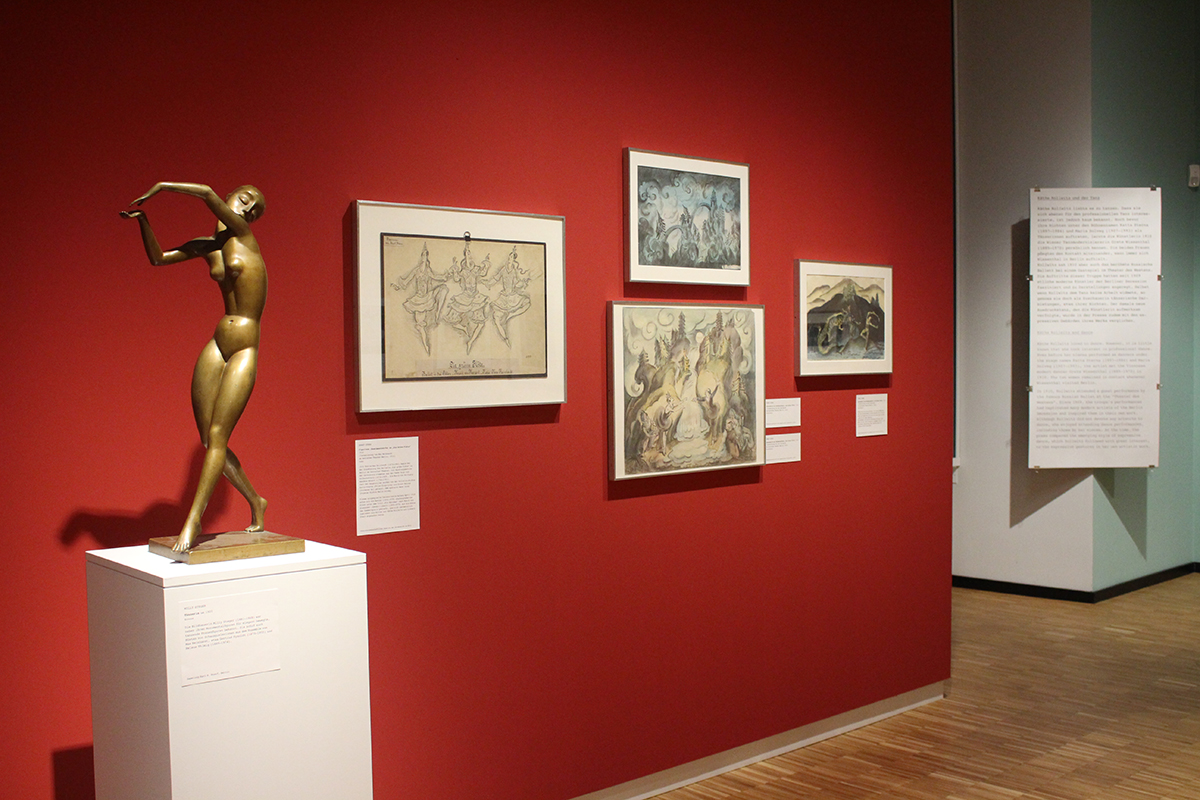
Käthe Kollwitz loved to dance. However, it is little known that she took interest in professional dance. Even before her nieces performed as dancers under the stage names Katta Sterna (1897–1984) and Maria Solveg (1907–1993), the artist met the Viennese modern dancer Grete Wiesenthal (1885–1970) in 1910. The two women remained in contact whenever Wiesenthal visited Berlin.
In 1910, Kollwitz attended a guest performance by the famous Russian Ballet at the “Theater des Westens”. Since 1909, the troupe’s performances had captivated many modern artists of the Berlin Secession and inspired them in their own work. Although Kollwitz did not devote any artworks to dance, she enjoyed attending dance performances, including those by her nieces. At the time, the press compared the emerging style of expressive dance, which Kollwitz followed with great interest, to the expressive gestures in her own artistic work.
exhibited works:
84
Milly Steger
Dancer
circa 1920
Bronze
Karl H. Knauf Collection, Berlin
In addition to her monumental figures, sculptor Milly Steger (1881–1948) was known for her elegantly moving, dancing female figures. She also created busts of actresses from Max Reinhardt’s ensemble, such as Gertrud Eysoldt (1870–1955) and Helene Thimig (1889–1974).
85
Ernst Stern
Figurines (costume designs) for “Die Grüne Flöte” (The Green Flute)
1916
(Production by Max Reinhardt at the Deutsche Theater Berlin, 1916)
Pen and ink
Theater Studies Collection of the University of Cologne
In 1916, Max Reinhardt (1873–1943) directed the premiere of the ballet “The Green Flute” at the Deutsches Theater in Berlin. The plot of the performance was penned by Hugo von Hofmannsthal (1874–1929), with music by Wolfgang Amadeus Mozart (1756–1791).
Two of the leading roles were danced by Kollwitz’s niece Katta Sterna (Prince Sing-Ling) and Ernst Matray (Wizard Wu), who later became the husband of her youngest niece Maria Solveg.
This well-rehearsed dance duo had already performed a piece choreographed by Matray (1891–1978) at the beginning of April 1916, entitled “Ein Märchen” (A Fairy Tale) to music by Alexander (Sándor) László (1895–1970) on the stage of the Kammerspiele, which was seen by at least Käthe Kollwitz’s mother and Lisbeth Stern.
86
Ernst Stern
Set design from Hofmannsthal’s “Die Grüne Flöte” (The Green Flute)
1916
(Production by Max Reinhardt at the Deutsche Theater Berlin, 1916)
Mixed media
Theater Studies Collection of the University of Cologne
87
Ernst Stern
Set design from Hofmannsthal’s “Die Grüne Flöte” (The Green Flute)
1916
(Production by Max Reinhardt at the Deutsche Theater Berlin, 1916)
Pastel, watercolor
Theater Studies Collection of the University of Cologne
88
Ernst Stern
Set design from Hofmannsthal’s “Die Grüne Flöte” (The Green Flute)
1916
Mixed media
Theater Studies Collection of the University of Cologne
Käthe Kollwitz saw a performance of the ballet pantomime at the Wintergarten in January 1917 and made only a brief note about her niece’s dancing: “Katrine is very graceful.”
From November 1925, Maria Solveg—who often performed with her sister—was also to appear as Princess Fay-yen in performances of “Die Grüne Flöte.”
89
Ernst Stern
Scene from “Das Mirakel” (The Miracle)
undated
(Production by Max Reinhardt at Circus Busch Berlin, 1914)
Mixed media
Theatre Studies Collection of the University of Cologne
Unlike the pantomime “Sumurûn,” the staging of Karl Gustav Vollmoeller’s (1878–1948) medieval-style mystery song and dance play “Das Mirakel” was another major project by Max Reinhardt (1873–1943). With an enormous investment in personnel and stage technology, the director premiered this stage work without spoken words in London. The production was an international success and enjoyed numerous revivals until the 1930s.
90
Ernst Stern
Figurines (costume designs) for “Das Mirakel” (The Miracle)
undated
(Directed by Max Reinhardt, premiered in London, 1911)
Ink, watercolor
Theater Studies Collection of the University of Cologne
The play “Das Mirakel,” with sets designed by Ernst Stern (1876–1954), did not premiere in Germany until 1914 at the Zirkus Busch in Berlin. Käthe Kollwitz saw the play in the same year together with her son Hans. She was apparently rather critical of pseudo-religious motifs, although one can also see reflections of some scenes in her later woodcuts.
Ernst Matray (1891–1978), who later married Kollwitz’s youngest niece (stage name Maria Solveg), danced the role of the shady minstrel in “Das Mirakel.”
91
Ernst Stern
The Sheikh’s Bedroom from “Sumurûn”
1910
(Production by Max Reinhardt at the Kammerspiele of the Deutsche Theater Berlin, 1910)
Crayon drawing
Theater Studies Collection of the University of Cologne
In 1910, Max Reinhardt (1873–1943) commissioned Grete Wiesenthal (1885–1970) to choreograph the Oriental-inspired dance pantomime “Sumurûn” by Friedrich Freksa (1882–1955), with music by Victor Hollaender (1866–1940). Ernst Stern (1876–1954) was responsible for the stage design and costume design. Wiesenthal also danced the title role.
While Kollwitz’s sons saw the performance immediately, Kollwitz did not see the piece until 1918. From 1924 onwards, her nieces Katta Sterna (1897–1984) and Maria Solveg (1907–1993) also danced in this piece, which was a great international success for Max Reinhardt.
92
Ernst Oppler
Les Sylphides
circa 1909
Lithograph
German Dance Archive Cologne / SK Foundation for Culture
When Käthe Kollwitz was invited by the Berlin Secession to a performance of the Ballets Russes at the Theater des Westens in May 1910, she saw a mixed program of various ballets, probably in excerpts.
This included the short ballet Les Sylphides, choreographed by Mikhail Fokine (1880–1942) to piano pieces by Frédéric Chopin (1810–1849), which has no plot.
93
Ernst Oppler
Les Sylphides (Behind the Scene)
Circa 1915
Lithograph
German Dance Archive Cologne / SK Foundation for Culture
94
Ernst Oppler
Les Sylphides (Behind the Scene)
Circa 1915
Drawing
German Dance Archive Cologne / SK Foundation for Culture
95
Hugo Lederer
Anna Pavlova Feeding a Deer
1928
Bronze
Karl H. Knauf Collection, Berlin
The Russian prima ballerina Anna Pavlova (1881–1931) was a member of the famous Ballets Russes and an international star. She had been friends with the sculptor Hugo Lederer (1871–1940) since the 1920s. She worked briefly in his studio and, under his guidance, created two portrait statuettes of herself, which were made in ceramic. Lederer himself portrayed the dancer in a genre scene that paid homage to Pavlova’s famous pointe work in an unusual pose.
96
Ernst Oppler
Les Sylphides (Behind the Scenes)
circa 1915
Oil on canvas
German Dance Archive Cologne / SK Foundation for Culture
The Ballets Russes company was founded in Paris in 1909 by impresario Sergei Diaghilev (1872–1929) with famous ballet stars from the Mariinsky Theater in St. Petersburg, such as Tamara Karsavina (1885–1978), Vaslav Nijinsky (1889–1950), and Anna Pavlova (1881–1931), and toured throughout Europe. Ernst Oppler (1867–1929)—whose brother Alexander (1869–1937), a sculptor, was a close acquaintance of Käthe Kollwitz—was one of the artists of the Berlin Secession for whom the Russian dancers’ performance in Berlin in 1909 was a profound experience. Today, he is considered the most important chronicler of stage dance in the 20th century.
97
Georg Kolbe
Dance Studies after Vaslav Nijinsky
1912
Pen and brush
Georg Kolbe Museum, Berlin
The dancer Vaslav Nijinsky (1889–1950) modeled for the sculptor longer than his colleague. Numerous sketches of movement sequences and detailed drawings testify to Kolbe’s (1877–1947) intensive study of the dance expression of this exceptional artist.
98
Georg Kolbe
Dancer Nijinsky
1919
Bronze
Georg Kolbe Museum, Berlin
The sculpture is a reworking of an earlier version from 1913, which was created immediately after the star dancer of the Ballets Russes, Vaslav Nijinsky (1889–1950), visited Kolbe’s studio. The Ballets Russes gave a long series of performances at the Kroll Opera in Berlin in 1912.
99
Georg Kolbe
Tamara Karsavina
1912
Brush, pencil, and ink
Georg Kolbe Museum, Berlin
The dancer Tamara Karsavina (1885–1978) was one of the stars of the Ballets Russes company. She and her dance partner Nijinsky (1889–1950) visited the sculptor in his studio in December 1912, where Kolbe (1877–1947) sketched movement studies of the two. There are also photographs from the sculptor’s studio showing Karsavina posing in costume. Using both models, Kolbe developed a group of figures for the Heinrich Heine monument in Frankfurt in 1913.
100
Josef Lorenzl
Caged Bird
Niddy Impekoven in a butterfly costume
1925
Porcelain, painted (manufacturer: Goldscheider, Vienna)
John Neumeier Foundation, Hamburg
In April 1920, Käthe Kollwitz wrote in her diary: “Saw Niddy Impekoven dance. Very talented. Great skill, temperament, charm.” Niddy Impekoven (1904–2002) was considered a dancing prodigy. After training in classical ballet, she turned to the then emerging art of expressive dance and, from 1918 onwards, developed solo programs for herself, including her choreography “Der gefangene Vogel” (The Caged Bird) to music by Bruno Hartl (1880–1939).
101
August Macke
Dancer
1914
Opaque colors, over washed ink drawing
Staatliche Museen zu Berlin, Kupferstichkabinett
The ballet Le Carnaval had an extremely stimulating effect on visual artists, as this work on paper by August Macke (1887–1914) shows. In addition to Macke and Ernst Oppler (1867–1929), Max Pechstein (1881–1955) also produced graphic works and a painting dedicated to this ballet.
102
Ludwig Kainer
Tamara Karsavina in the “Polovtsian Dances”
undated
Lithograph, hand-colored
John Neumeier Foundation, Hamburg
In addition to classical dances, the Ballets Russes also had pieces with folkloric elements in their repertoire. The “Polovtsian Dances” to music by Alexander Borodin (1833–1887) originated in the opera “Prince Igor,” and Fokine (1880–1942) had reworked them into a ballet in its own right.
103
Ludwig Kainer
Adolph Bolm in the “Polovtsian Dances”
undated
Lithograph, hand-colored
John Neumeier Foundation, Hamburg
The “Polovtsian Dances,” with their wildness and supposed “barbarism,” were one of the showpieces of the Ballets Russes.
104
Ernst Oppler
Adolph Bolm in the “Polovtsian Dances”
1914
Pencil and ink
John Neumeier Foundation, Hamburg
Käthe Kollwitz particularly appreciated the “Polovtsian Dances” in the Ballets Russes performance she attended, which were always one of the highlights of the ensemble’s tour program. During the Berlin guest performance in 1910, Mikhail Fokine (1880–1942) took on the role in the “Polovtsian Dances” that was actually the signature role of Adolph Bolm (1884–1951). The study by Ernst Oppler (1867–1929), which sketches Bolm in motion on stage, was created during another performance, but it still conveys the impression that Käthe Kollwitz had at the time.
105
Ernst Oppler
Le Carnaval
circa 1917
Etching, drypoint
German Dance Archive Cologne / SK Foundation for Culture
On May 20, 1910, one day before Käthe Kollwitz saw the Ballets Russes perform a mixed program on stage, a new ballet choreographed by Mikhail Fokine (1880–1942) premiered at the Theater des Westens. Le Carnaval, based on the piano suite of the same name by Robert Schumann (1810–1856) and featuring costumes by Léon Bakst (1866–1924), is one of the company’s most legendary pieces. Ernst Oppler (1867–1929) depicts dancers Tamara Karsavina (1885–1978) and Vaslav Nijinsky (1889–1950) here.
106
Paul Poiret
Vera Fokina and Mikhail Fokine in “Cléopâtre”
undated
Ink and watercolor
John Neumeier Foundation, Hamburg
The 1910 program of the Ballets Russes also included the ballet “Cleopatra.” The choreography was also by Mikhail Fokine (1880–1942) and was based on music by several composers, including Nikolai Rimsky-Korsakov (1844–1908) and Modest Mussorgsky (1839–1881).
107
Paul Scheurich
Mikhail Fokine and Vera Fokina in “Cléopâtre”
undated
Porcelain, colored
John Neumeier Foundation, Hamburg
Scheurich’s enthusiasm for the Ballets Russes’ guest performance in Berlin inspired him to create several porcelain dance figures, including a five-piece group that was produced by the Meissen manufactory. The sculptor succeeded in precisely characterizing the various members of the ensemble with his porcelain sculptures.
brief introduction to the authors:
Ernst Stern
(Bukarest 1876–1954 London)
After studying at the Munich Art Academy, Stern initially worked as an illustrator for the well-known magazines “Jugend” and “Simplicissimus”. In 1905, Stern moved to Berlin and became a member of the Secession. He quickly rose to become chief set designer at the Reinhardt Theatres, and in the 1920s designed sets for operas, revues, and films. Stern continued to work as a visual artist and created several portfolios of prints. After 1933, Stern emigrated to London.
Hugo Lederer
(Znaim 1871 – 1940 Berlin)
After training in arts and crafts, Lederer worked in Berlin from 1893 onwards. From 1900 onwards, his beautifully sculpted, Art Nouveau-influenced figures were joined by stylized monumental sculptures, which made him one of the most sought-after commissioned sculptors in the German Empire. He greatly admired the dancer Anna Pavlova and created several depictions of her, the most popular of which was the sculpture with the feeding deer.
Ludwig Kainer
(München 1885 – 1967 Paris)
Kainer initially began studying medicine, but turned to the fine arts during a stay in Paris. Here, in 1909, he also made contact with the Ballets Russes, which led to an artistic collaboration. Kainer created spirited depictions of the ballet troupe with their imaginative costumes. From 1910 onwards, he lived in Berlin and worked as a commercial artist and illustrator. Later, he worked in film and as a costume and stage designer. In 1933, Kainer first emigrated to Switzerland and later moved to Paris.
Georg Kolbe
(Waldheim 1877 – 1947 Berlin)
Kolbe initially studied painting in Dresden, Munich, and Paris, before turning to sculpture in Rome around 1900. He moved to Berlin in 1904, where he made his breakthrough in 1912 with his sculpture “Dancer.” Kolbe influenced the “expressive sculpture” of the period before World War I with his restrained, moving nude figures and soon became one of the most successful German sculptors. During the Nazi era, his works were accepted, although he was not one of the regime’s favorites.
Erwin Lang
(Wien 1886 – 1962 Wien)
Lang attended the Vienna School of Arts and Crafts from 1903 onwards, and by 1906 he was already working as a stage designer in Vienna, later followed by further work for Max Reinhardt in Berlin. Lang was a member of the Hagenbund artists’ group and was known for his woodcuts, some of which featured his first wife, Grete Wiesenthal, as their motif.
Josef Lorenzl
(Wien 1892 – 1950 Wien)
Lorenzl initially worked as a metal caster in a bronze casting workshop and later created dance-like figures in the Art Deco style as a sculptor and ceramist. The sculpture “Gefangener Vogel” (Captive Bird), created for the Viennese manufacturer Goldscheider and based on a dance figure by Niddy Impekoven, became his most famous work.
August Macke
(Meschede 1887 – 1914 Champagne)
Macke began studying at the Düsseldorf Art Academy in 1904, accompanied by numerous study trips. He worked temporarily in Lovis Corinth’s studio in Berlin. In 1910, he developed a friendship with Franz Marc, and later with Wassily Kandinsky, Gabriele Münter, and Alexej Jawlensky. Macke joined the “Blauer Reiter” artists’ association in Munich and helped shape Rhenish Expressionism. Macke lost his life in World War I.
Ernst Oppler
(Hannover 1867-1929 Berlin)
After studying art at the Munich Academy, Oppler enjoyed early success with works in the style of the Munich School, but soon became a member of the Munich and Berlin Secession. During a stay in London lasting several years, he devoted himself intensively to the technique of etching and, from 1900 onwards, developed an impressionistic style of painting. After moving to Berlin in 1904, he focused intensively on the motif of dance, with his technically sophisticated etchings attracting particular attention.
Paul Poiret
(Paris 1879 – 1944 Paris)
Poiret was one of the most famous fashion designers of the Art Deco period. After completing his apprenticeship at several Parisian fashion houses, he set up his own business in 1903 with an exclusive salon. The performances of the Ballets Russes in Paris inspired him to create his own Far Eastern-style designs.
Paul Scheurich
(New York 1883 – 1945 Brandenburg/Havel)
Scheurich came to Berlin as a child and received a brief academic education there. He created his first models for porcelain sculptures around 1910 for the Schwarzburg workshops. With figures in reduced forms, he brought porcelain sculpture into the modern era. His works were produced in the manufactories of Berlin and Meissen. Scheurich was also active as a draftsman and graphic artist.
Milly Steger
(Rheinberg 1881 – 1948 Berlin)
Steger first studied at the School of Applied Arts in Eberfeld and later received private lessons from the sculptor Karl Janssen from Düsseldorf. From 1910 onwards, she lived in Hagen, where she created monumental architectural sculptures. Her work was complemented by independent pieces that often incorporated elements of dance. From 1928 onwards, Steger taught at the teaching institute of the Association of Berlin Women Artists.
plays in brief:
Cleopatre
Cleopatra, the Egyptian queen, seduces powerful men, manipulating politics and love to her advantage. Intrigues, passions, and rivalries come to a head—a game of power, seduction, and tragedy that ends in death.
Les Sylphides
In “Les Sylphides”, a young man wanders through a foggy forest at night. He encounters shy sylphs, fleeting spirits of the air, who circle around him and seduce him. In the end, he remains alone, caught between dream and reality, longing and transience.

Carnaval
“Carnaval” depicts episodes from a masked ball: scenes full of dancing, flirting, jealousy, and comedy alternate. Lovers encounter rivals, masked figures play pranks, and festivities escalate into chaos.
Sumurun
“Sumurun” tells the story of a traveling theater troupe that arrives at the court of of a Far Eastern ruler. The old director desires the young dancer Sumurun, who, however, loves a young actor. The ruler himself also desires her. Secret meetings, jealousy, and abuse of power drive the characters against each other. When intrigues are uncovered, desire and rivalry lead to betrayal, murder, and a deadly end.
The green Flute
Ballet pantomine
In „The Green Flute“, a young prince receives a magic flute that enchants people. In his search for love, he encounters a sorcerer who pits power against desire. Deceptions, seductions, and trials lead the prince to realize that true fulfillment comes not from magic, but from inner maturity. The plot unfolds wordlessly through dance and gestures.
The Miracle
The young nun Maria leaves her convent out of a longing for life and love. Meanwhile, an angel takes her form and keeps her place. Maria finds herself in need and temptation in the city, but eventually returns to the convent – tired, hurt, but unbroken. “The Miracle” tells an impressive story of grace, temptation, and the power of divine mercy.