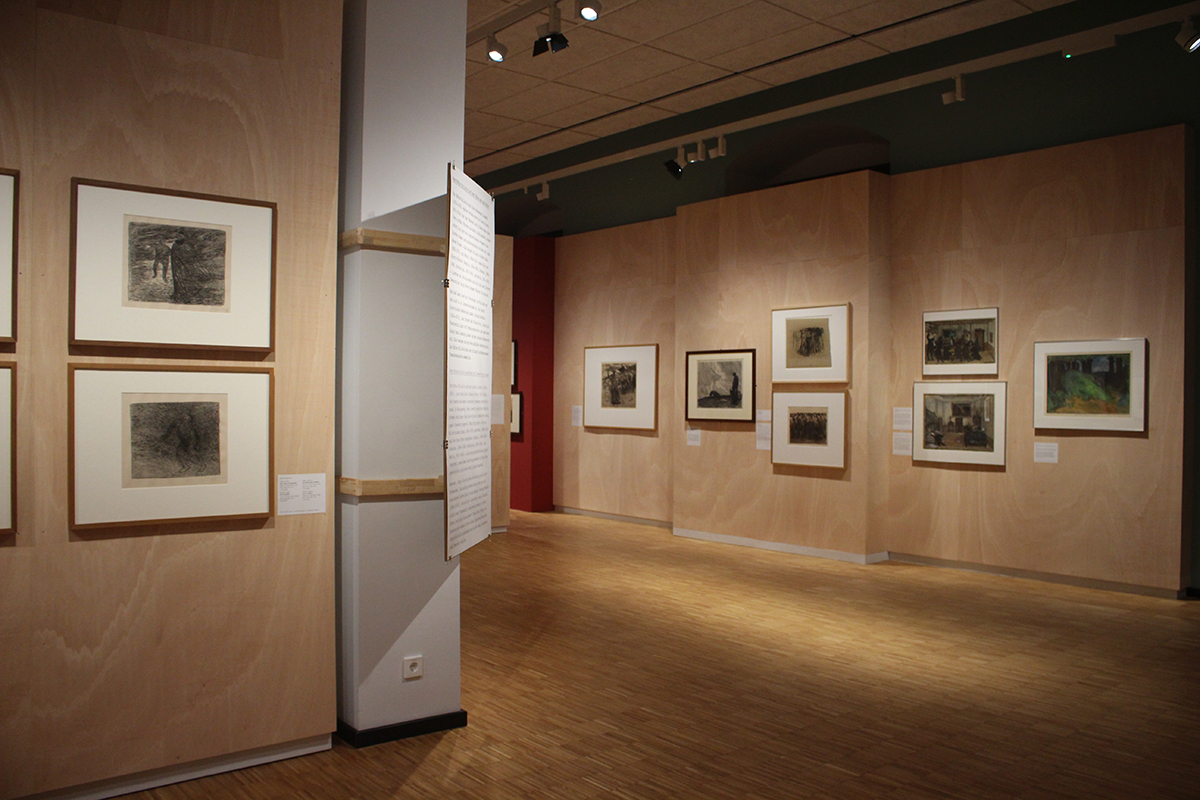
For Käthe Kollwitz and her sister Lisbeth (1870–1963), later married to Georg Stern (1867–1934), the theater had been a constant presence since childhood. In Königsberg, they loved to perform classical dramas and plays they had written themselves using paper theater puppets. Their children – the two Kollwitz sons (Hans, 1892–1970, and Peter, 1896–1914) and the four Stern daughters (Regula, 1894–1980, Johanna, 1896–1988, Katharina, 1897–1984, and Maria, 1907–1993) – also enjoyed performing plays together, sometimes involving members of the older generation in private family performances.
However, they also enjoyed attending public performances, including productions that are now considered historically significant. Konrad Schmidt (1863–1932), the artist’s brother, was a theater critic and frequently received premier tickets, often inviting his sisters’ families. Here, we reconstruct some of the visual impressions that Käthe Kollwitz gathered during her many documented theater visits.
exhibited works:
30
Lovis Corinth
Rudolf Rittner as Florian Geyer
circa 1915
Watercolor and black chalk, heightened with opaque white
Staatliche Museen zu Berlin, Kupferstichkabinett
The actor Rudolf Rittner (1869–1943) played the title role in the new production of Hauptmann’s Peasant War drama Florian Geyer at the Lessingtheater in Berlin in 1904. The stage design and costumes were by the painter Max Slevogt (1868–1932). Rittner was known to Käthe Kollwitz as Moritz Jäger from the premiere of “The Weavers.” Lovis Corinth (1858–1925) was so impressed by the actor that he depicted him several times in the costume and pose of Florian Geyer.
There is evidence that the artist was familiar with Hauptmann’s play. However, we do not know whether she saw it on stage, and it has not yet been investigated whether it had any influence on her cycle on the Peasants’ War. Kollwitz herself rejected belles-lettres as a source for her work.
31
Käthe Kollwitz
Uprising
1899
Etching, drypoint, aquatint, brush etching, emery, and some roulette in black and red on copperplate paper
Staatliche Museen zu Berlin, Kupferstichkabinett
This etching represents the artist’s first engagement with the theme of the German Peasants’ War of 1524/25, to which she later devoted a cycle. Like Gerhart Hauptmann (1862–1946) for his drama, Kollwitz also states that her source for this was Wilhelm Zimmermann’s (1807–1878) historical treatise.
The question arises as to whether she was not inspired to deal with the subject by the premiere of Florian Geyer in 1896. A comparison with Corinth’s watercolor reveals two defining elements that are found in both Corinth’s and Kollwitz’s works: the flag and the fire.
40
Käthe Kollwitz
Outbreak
Sheet 5 from the cycle Peasants’ War
1902/03
Etching, line etching, drypoint, aquatint, and vernis mou
Käthe Kollwitz Museum Berlin
In her series Peasants’ War, Käthe Kollwitz took up for the first time the motif of the (human) crowd, which had emerged with the industrial age and was a theme in contemporary theater. According to a psychological theory by Gustave Le Bon (1841–1931), a group of individuals can merge into a crowd in which the individual disappears. This mass acts like a living being, led by individuals who emerge from it as leaders.
The print “Outbreak” reveals revolutionary energies. The mass of farmers charging forward in a wedge formation forms an inextricable mixture of limbs, heads, and weapons. Only a few individuals can be distinguished.
41
Käthe Kollwitz
Ploughman with standing woman in the foreground
Rejected third version of plate 1 from the Peasants’ War cycle
1906?
Etching, needlepoint and vernis mou with transfer print on copperplate paper, reworked with pencil, opaque white and brown ink
Staatliche Museen zu Berlin, Kupferstichkabinett
This early version of the first sheet in the etching series “Peasants’ War,” entitled “The Ploughmen,” once again highlights the theatrical nature of Käthe Kollwitz’s pictorial concepts. As on a stage, the scene is divided into a foreground and a distant background. In the theater, this background would be represented as a painted backdrop. The figures depicted present us with a story from the past for which we have no pictorial documents.
42
Käthe Kollwitz
The Prisoners
1908
Charcoal on brown paper
Käthe Kollwitz Museum Cologne
43
Käthe Kollwitz
The Prisoners
Sheet 7 from the cycle Peasants’ War
1908
Etching, line etching, drypoint, emery, and vernis mou
Käthe Kollwitz Museum Berlin
While the peasants, huddled together after their defeat, are primarily preoccupied with themselves in the upper composition drawing, the final version of the sheet shows a figure in the center that is particularly emphasized. She seems to be the only one staring intently at the viewer. With this figure, the artist invites us to empathize with the miserable situation of the prisoners.
It seems as if Käthe Kollwitz had the later viewer in mind when she created her design, as someone who could be addressed directly. Like the performers on stage, she was also aware that she had an audience to whom she wanted to communicate something.
44
Emil Orlik
The Tavern on the Border with Saxony from Schiller’s “The Robbers”
1908
Gouache
Theater Studies Collection of the University of Cologne
The scene in this tavern is similar in structure to Kollwitz’s etching “Four Men in a Pub.” In this tavern scene, too, a dramatic conflict comes to a head. Here, the ‘good’ brother Karl receives a message forged by his “evil” brother that their father has disowned him.
Orlik (1870–1932) also places a group of men with their backs to the viewer in front of a window. With appropriate stage lighting from behind, the shadows cast here and there would suggest that events arising from the situation are about to unfold.
45
Emil Orlik
Franz Moor’s Room in Schiller’s “The Robbers”
1908
Gouache
Theater Studies Collection of the University of Cologne
In 1908, Emil Orlik (1870–1932) was commissioned by director Max Reinhardt (1873–1943) to design the sets for his new production of Friedrich Schiller’s (1759–1805) drama “The Robbers” at the Deutsches Theater Berlin. Paul Wegener (1874–1948) took on the role of the jealous Franz.
It is likely that Käthe Kollwitz saw this production on stage. On the one hand, she held her colleague Orlik in high regard, and on the other, she had also performed the play with paper theater puppets together with her sister Lisbeth in her childhood. In addition, her brother Conrad had published a positive review of this production.
46
Emil Orlik
Area on the Danube for Schiller’s “The Robbers”
1908
Gouache
Theater Studies Collection of the University of Cologne
The stage design shows the hideout of Franz Moor’s band of robbers, which was located in the woods on the Danube.
When Hans Kollwitz wanted to become an actor after graduating from high school, his parents asked the famous actor Paul Wegener for his opinion. In 1909, Hans auditioned for him with a part from The Robbers, among others, but was unsuccessful. At the same time, Wegener was playing Franz Moor in a current production of the play.
47
Johann Ferdinand Schreiber (publisher)
The Robbers
No. 504, picture sheet
after 1877
Paper, printing techniques
Berlin City Museum Foundation
Not only Käthe Kollwitz, but also her sister Lisbeth could still remember playing with paper theater puppets as children. She recalled that the two of them had played with characters from Friedrich Schiller’s play The Robbers, among others.
48
J. F. Schreiber (manufacturer)
Paper theater with proscenium, Berlin
circa 1900
Theater with architecturally structured stage, wooden frame for changing backdrops, stage set “Forest” by Schreiber, Esslingen, and figures for Schiller’s Robbers.
Berlin City Museum Foundation
As a young girl, Käthe Kollwitz loved to play theater with paper figures together with her sister. These were bought as picture sheets, colored with ink, and then cut out. The sisters did not have a perfect theater, but made do with building blocks, chairs, and tables.
This stage for cardboard figures is nevertheless interesting because it shows how a scene was staged in large theaters at that time: painted backdrops were either pushed onto the stage from the side or lowered from above from a pull-down ceiling.
49
Emil Orlik
Portrait of Hermann Bahr
1908
Etching, drypoint, roulette in brown-black
Private collection, Cologne
In 1948, Hans Kollwitz remembered his mother as a person who had a great sense of humor and loved to laugh. The artist is known to have enjoyed performances of comedies such as “Das Konzert” (The Concert) and “Das Prinzip” (The Principle) by Hermann Bahr. She saw the latter comedy in January 1913 together with her husband and son Peter.
On “The Principle”
Of the many comedies written by Bahr, this last one can best be compared to his masterpiece, the effervescently funny “Concert.” Carried by an excellent performance, his cheerful mood swept the audience along; one could not only laugh out loud, but also quietly enjoy the approval of one’s intellect. The surprise was all the more pleasant given that “Children” and “The Little Dance”, the two comedies that appeared after “Concert,” seemed to signal an inability to develop further. Certainly, “The Principle” is also fleeting, if you will. The author does not care about a handful of improbabilities, even impossibilities; he glosses over many important things and sketches the humanitarian world-improvement enthusiast Esch, who according to the title should be the main character, with only a few very caricatured strokes. But this summarily erratic approach works at the same time with such daring élan, such a wealth of ideas, contrasts, and meaningful psychological insights that one is happy to accept it as “poetic license.”
Conrad Schmidt: Vorwärts, 21.1.1913
50
Emil Stumpp
Portrait of Alfred Kerr
1926
Lithograph
German Historical Museum Foundation, Berlin
Alfred Kerr (1867–1948) initially studied German language and literature in Breslau and Berlin and wrote his first newspaper articles while still a student. He became one of the most renowned theater critics of his time, writing for various newspapers, including the Vossische Zeitung and the Frankfurter Zeitung. Kerr was friends with Gerhart Hauptmann and had supported him in his younger years.
51
Ernst Stern
Four stage sets from “Danton’s Death”
1916
(Production by Max Reinhardt at the Deutsches Theater Berlin, 1916)
Pen and ink
Theater Studies Collection of the University of Cologne
After attending the play in December 1916, Käthe Kollwitz wrote in her diary: “Very powerful. Final scene: the guillotine on the Place de la Bastille. Two drunken servants sweep the blood from the steps and leave, bawling. The triumph of madness.”
52
Ernst Stern
Bridge in Paris
1916
Stage design (squared) for “Danton’s Death”
(staged by Max Reinhardt at the Deutsche Theater Berlin, 1916)
Pencil, watercolor
Theater Studies Collection of the University of Cologne
Alexander Moissi (1879–1935) also played the leading role in Max Reinhardt’s (1873–1943) production of Georg Büchner’s (1813–1837) drama “Danton’s Death,” which Käthe Kollwitz saw at the end of 1916. She was so impressed by the performance that she sent her sister Lisbeth and her son Hans to the next performance.
The squaring on this draft shows that Stern’s image idea was enlarged directly to create a background stage set for the production. This makes it possible to understand the visual impression that Kollwitz had on stage.
On “Danton’s Death”
The play at the Deutsches Theater flew by at a rapid pace, with Reinhardt’s usual imaginative and atmospheric staging of the crowd scenes. The first scene shows the great revolutionary, tired of politics, sitting at a card table surrounded by his friends, listening to a frivolous young woman recount her adventures. The stage darkens, and amid shrill cries, the image of lighthearted enjoyment is transformed into a picture of the terrible hardship facing the people.
[…] An aristocrat who has strayed into the crowd is to be punished for his pristine clothes by being hung from a lamppost, but escapes death at the last moment. What good are the severed heads of aristocrats to you, cries a street agitator, when your skirts are full of holes and your stomachs remain empty and hungry? Courage and despair mingle with excited laughter and the dance of the Karmagnole. […]
At the end, Reinhardt was called out stormily.
Conrad Schmidt: Entertainment section of Vorwärts, December 17, 1916
53
Sándor Járay
Portrait of Austrian actor Alexander Moissi
Model circa 1915 (?)
Bronze
Berlin City Museum Foundation
Käthe Kollwitz greatly admired Alexander Moissi (1879–1935) in various roles. She found the actor to be “enchantingly charming and spirited” in his portrayal of Everyman. In 1912, she wrote to her son Hans: “Except for Hamlet, I have never seen him perform so well.”
Audio recording
Alexander Moissi
Monologue from Shakespeare’s “Hamlet”
Original recording from 1912
Deutsche Grammophon-Aktiengesellschaft
Saxon State Library – Dresden State and University Library
Listen to what Käthe Kollwitz heard on stage: Alexander Moissi (1879–1935) recites the famous Hamlet monologue from the third act about “to be or not to be.”
Scan the QR-Code on the object label.
54
Fritz Erler
Design for Hamlet, Prince of Denmark
Scenes I.1 and I.4, 1909
Oil on canvas
Theater Studies Collection of the University of Cologne
It is unclear when Käthe Kollwitz saw the production of Hamlet that Max Reinhardt staged at the Deutsches Theater in 1909. In a letter to her son Hans in 1912, she mentions in passing that she found the actor Alexander Moissi (1879-1935) particularly good in the role of Hamlet.
On “Hamlet”
[…]The decorations were extremely simple, clearly modeled on those of the Munich Artists’ Theater, whose limited space he had to contend with. Only the snow-covered castle terrace, the tall forest of halberdiers’ spears, and perhaps Ophelia’s funeral procession, dark against the light sky, had something pictorially imaginative about them, despite the great simplicity of the stylization. The sketches of the castle chambers and galleries were characterized by a restraint that here and there went too far and turned into sobriety. […]
The highlight of the evening, a triumph for the actor Reinhardt himself, who, despite initial failures, unwaveringly challenged his talent—which had been marred by severe affectation—with ever new and greater tasks, was Moissi’s Hamlet. […]
He was a handsome prince, yet without the slightest hint of conventional theatrical idealization, marked by the finest intellectualism, amiable and gentle by nature, a deeply introspective man who, thrown off course by a terrible experience, fought in vain against his paralysis with shame and fear.
Conrad Schmidt: Vorwärts, 19.10.1909
On “Hamlet”
Virtues and shortcomings of the performance… The virtue lay in its greater simplicity. […] Now, in “Hamlet”… the core space remains virtually unfilled, but nowhere do secondary matters become the main focus.[…]
Hamlet, a conversation piece. In some places, quite rightly so. Twenty years after the founding of the Freie Bühne, people in their city certainly speak more naturally […]
The most serious flaw, in my opinion, lies in the lack of control over the individual parts. The line towards the end becomes wavering, dull. A great director, it seems to me, brings intensity; he brings a sense of the whole; here, it is piece by piece (and fading towards the end)… the second half is fleeting… I don’t notice any growth in what has been achieved… One sees a tasteful Hamlet drama. Much of it is neatly toned, attuned, appealing, refined, delicious. I don’t want to say: a charming Hamlet. But instead of mythical clouds, something well-defined. […]
Moissi (with all his charms) was not a creature obsessed with ultimate questions. […]
A touching little Hamlet, yes. […] Alongside all the wonderful things. But we knew he had that. He was even charming … Except that he wasn’t that man in that play.
Alfred Kerr: Der Tag Nr. 245, 19.19.1909
55
Fritz Erler
Design for “Hamlet” 1909
Mixed media
Theater Studies Collection of the University of Cologne
Max Reinhardt (1873–1943) staged William Shakespeare’s (1564–1616) drama “Hamlet” in 1908 at the Künstler-Theater in Munich and in 1909 at the Deutsche Theater in Berlin.
60
Hans Strohbach
Stage/set design for “Masse Mensch” (Mass Man)
1921
(Production by Jürgen Fehling at the Berliner Volksbühne, 1921)
Mixed media
Theater Studies Collection of the University of Cologne
Käthe Kollwitz saw this drama by Ernst Toller (1893–1939) on stage in February 1922, together with a relative, and then wrote about it in her diary:
“It moved me deeply. How he expresses everything that one has tossed and turned over in one’s mind to the point of torment. In the end: ‘One must sacrifice only oneself.’ / The tense, chained masses of workers, upon whom machine-gun fire is unleashed and who sing the Marseillaise, roar, rage—it’s enough to drive one mad.”
61
Hans Strohbach
Stage/set design for “Masse Mensch” (Mass Man)
1921
(Production by Jürgen Fehling at the Berliner Volksbühne, 1921)
Mixed media
Theater Studies Collection of the University of Cologne
62
Hermann Krehan after Robert Neppach
Stage/set design for “Die Wandlung” (Transfiguration)
undated
(Production by Karlheinz Martin at Die Tribüne Berlin, 1919)
Gouache
Theater Studies Collection of the University of Cologne
On October 12, 1919, Käthe Kollwitz recalled in her diary that she had seen her son Peter for the last time on that day five years earlier, shortly before he was killed in World War I on the Western Front in Flanders. Against this backdrop, she was reluctant to attend the evening performance of Ernst Toller’s (1893–1939) play Die Wandlung (The Transformation) with her husband and son Hans.
The production of the play was a resounding success, also for the leading actor, the young Fritz Kortner (1892–1970), who would later marry Kollwitz’s niece Hanna—stage name Johanna Hofer. Another novelty was the innovative stage design, which dispensed with any spatial illusion.
63
Ernst Barlach
Encounter on the heights (top left)
Reception under a tent (top right)
Mountain forest with the ark (bottom left)
Noah and Calan (bottom right)
Illustrations for the drama “The Sin Flood”
1924
Charcoal drawings
Ernst Barlach Haus – Stiftung Hermann F. Reemtsma, Hamburg
In January 1939, Käthe Kollwitz reported that she had attended a gathering in honor of the deceased and ostracized Ernst Barlach (1870–1938): “The Flood was read. […] It made a huge impression.”
However, she had probably not seen the 1925 production of the play directed by Jürgen Fehling at the Prussian State Theater.
64
Ernst Barlach
The Couple in Conversation, sheet 3 (top left)
Appearance in the Fog, sheet 24 (top right)
The Caller, sheet 22 (bottom left)
Call in the Fog, sheet 23 (bottom right)
Lithographs from the series The Dead Day
Ernst Barlach Haus – Stiftung Hermann F. Reemtsma, Hamburg
In December 1913, Käthe Kollwitz wrote in her diary:
“Read Barlach’s ‘Toten Tag’ (Dead Day) and was deeply moved by it. […] What grips me is the mother and her son. How he then wriggles free from her and calls for his father. And yet cannot reach God in all the fog. And returns to his mother’s side.”
In 1916, the artist also viewed the lithographs of Ernst Barlach (1870–1938) in an exhibition. Unlike with the drama Die echten Sedemunds, it is unclear whether she also attended the performance of the play at the Neues Volkstheater in 1923.
brief introduction to the authors:
Emil Orlik
(Prag 1870–1932 Berlin)
After studying in Munich and working independently in Prague, Orlik was appointed head of the graphic arts class at the Berlin School of Arts and Crafts in 1905. He was a member of the Berlin Secession and made a name for himself as a portraitist of numerous figures from the performing and visual arts. Orlik also created designs for stage sets and costumes. He undertook numerous long-distance journeys and was inspired by Japanese woodblock prints.
Ernst Stern
(Bukarest 1876–1954 London)
After studying at the Munich Art Academy, Stern initially worked as an illustrator for the well-known magazines “Jugend” and “Simplicissimus”. In 1905, Stern moved to Berlin and became a member of the Secession. He quickly rose to become chief set designer at the Reinhardt Theatres, and in the 1920s designed sets for operas, revues, and films. Stern continued to work as a visual artist and created several portfolios of prints. After 1933, Stern emigrated to London.
Ernst Barlach
(Wedel 1870–1938 Rostock)
Barlach received his artistic training in Hamburg and Dresden. From around 1900 to 1910, he lived in Berlin with interruptions and was represented there by gallery owner Paul Cassirer. A trip to Russia in 1906 was decisive for his artistic development. Coming from Art Nouveau, Barlach developed his own expressive style with concise, block-like figures. Barlach was a member of the Berlin Secession and, from 1919, the Prussian Academy of Arts. Under the Nazis, his works were considered “degenerate.”
Fritz Erler
(Frankenstein 1868 – 1940 München)
Erler studied in Breslau and Paris between 1886 and 1894. He soon made a name for himself as a mural and decorative painter, his monumental paintings often depicting themes from Germanic mythology. During World War I, he produced war paintings for propaganda purposes. His portrait work was devoted to artists and musicians, and from 1933 onwards also to leading Nazi politicians.
Sandor Jaray
(Temesvar 1870 – 1943 London)
Jaray initially studied acting and later turned to sculpture. His connections to the stage can be traced in many of his sculptural works. His most famous work is his portrait statue of the Viennese actor Josef Kainz in the role of Hamlet. He also created portraits of other actors. Jaray emigrated to England in 1938.
Kolomann Moser
(Wien 1868 – 1918 Wien)
Moser first studied at the Vienna Academy, then at the School of Applied Arts, and began working as an illustrator at an early age. He was one of the founders of the Vienna Secession and designed window decorations for the famous Secession building. In 1900, he was appointed professor at the School of Applied Arts and went on to design decorative arts objects, furniture, interior designs, and stage sets.
Robert Neppach
(Wien 1890 – 1939 Zürich)
After studying classical art in Munich, Neppach was hired as a stage designer at the Frankfurt New Theater. After World War I, he moved to Berlin, where he worked both for the theater and for the young medium of film. His stylized scenography, which drew on Expressionism, had a formative influence on the style of the time. In 1932, he founded his own film production company, which he was forced to give up in 1936. Neppach emigrated to Switzerland and committed extended suicide.
Max Slevogt
(Landshut 1868 – 1932 Leinsweiler)
Slevogt studied in Munich and Paris and was one of the most versatile artists of his time. From 1901 he lived in Berlin and was a member of the Berlin Secession. In addition to lively Impressionist paintings, he created drawings and prints and worked as an illustrator and stage designer.
Hans Strohbach
(Sebnitz 1891 – 1949 Frankfurt/Main)
Strohbach worked as a stage designer in Berlin in the 1920s, including for the Volksbühne theater, before later moving to Dresden.
plays in brief:
The Concert
In the comedy “Das Konzert” (The Concert), the famous, adored pianist Gustav Heink uses alleged concert tours as a pretext to start affairs with schoolgirls in a mountain hut. His wife Marie, who usually tolerates this, travels after the adulterers with the husband of his current lover (Delfine), which leads to the couple rediscovering their relationship.
The Principle
Former pastor Friedrich Esch preaches the principle of free development and self-determination for all people. When Esch’s own children put his principles into practice, with his son becoming engaged to the old cook and his daughter eloping with the gardener, the pastor learns just how absurd his dogmatism can be.
The Dead Day
In “Der tote Tag” (The Dead Day), Ernst Barlach tells a dark parable about isolation, guilt and human powerlessness. On a seemingly “dead day” a man realizes that his life is marked by indifference and missed opportunities. His inner emptiness is reflected in encounters with strangers until he is forced to accept the bitter truth about responsibility and mortality – a poetic, quiet drama between dream and reality.
The Real Sedemunds
The fate of the Sedemund family unfolds in a small town in Lower Germany. A rumor about an escaped lion stirs up fears and reveals hidden conflicts. In the conflict between father and son, guilt, sin, and family entanglements come to light—especially in the shadow of the mother’s suicide. Barlach paints a multifaceted picture of human responsibility, identity, and the search for authenticity in human existence.

The Sin Flood
In “Die Sündflut” (The Sin Flood), Ernst Barlach depicts the life of a community threatened by a devastating flood. As the water rises, relationships break down, old conflicts resurface, and people search for someone to blame. Some cling to possessions and power, others to compassion and hope. In the end, it is decided who will be saved – and who will perish.

Danton’s Death
Georg Büchner’s “Danton’s Death” takes place during the French Revolution. The once celebrated revolutionary leader Georges Danton comes into conflict with Robespierre and the Committee of Public Safety. Mistrust, intrigue, and political power struggles lead to his arrest. Despite a passionate defense, Danton and his comrades are brought to trial, convicted, and ultimately executed—a sequence of events that reveals the full extent of revolutionary terror.
Florian Geyer
Gerhart Hauptmann’s “Florian Geyer” is set during the German Peasants’ War. The Franconian knight Florian Geyer sides with the rebellious peasants and leads the “Black Troop” against princes and nobility. While the movement initially gathers strength, it eventually falls apart due to internal tensions, violence, and betrayal. The uprisings are crushed, Geyer falls victim to an assassination, and the Peasants’ War ends in bloody defeat.
Everyman
The play is a modern mystery play about the death of a rich, selfish man. The wealthy Everyman leads a wicked life and is unexpectedly summoned by the Death to appear before God’s court. In his final hour, his lovers, friends, and relatives abandon him, and he realizes that all material possessions are fleeting. At the last minute, he finds faith, repents his sins, and is saved by God’s grace.
The Robbers
In “Die Räuber” (The Robbers), Karl turns his back on his father, outraged by his stricness, and becomes the leader of a band of robbers to fight against social injustice. His brother Franz plots to steal the inheritance and manipulates their father and others. Betrayal, violence, and love entangle the characters until Karl’s idealism and Franz’s selfishness culminate in a decisive confrontation that reveals guilt, remorse, and the destructive power of human passion.

Hamlet
Prince Hamlet learns from the ghost of his deceased father that his uncle Claudius murdered him in order to take the throne. Hamlet vacillates between revenge and doubt, feigns madness, observes intrigues at court, and tests loyalties. In a web of deception, duels, and retribution, mistrust and lust for power lead to betrayal, death, and destruction, ultimately shattering the royal family.

Transfiguration
“Die Wandlung” (Transfiguration) tells the story of Friedrich, a war volunteer who goes into World War I full of idealism. At the front, he is confronted with death and senselessness. Wounded, he returns home, becomes a political activist, and participates in revolutionary plans. But here, too, he experiences violence, betrayal, and failure. In the end, Friedrich realizes that true change is not possible through coercion, but through an inner moral transformation of the individual.

Masses and Men
A young revolutionary returns from war to find a society that has fallen into indifference and violence. Desperate, he searches for meaning and moral guidance, while the people around him become part of a manipulable, emotionally cold mass. Driven by outrage and powerlessness, he fights for responsibility, humanity, and rebellion—but the masses seem stronger than the individual.