Side Events
SLOW ART GUIDED TOUR
December 3, 2026 at 17:00
featuring selected works by Klaus Hack
ARTIST TALK
January 10, 2027 at 11:00
Klaus Hack in conversation with Dr. Josephine Gabler
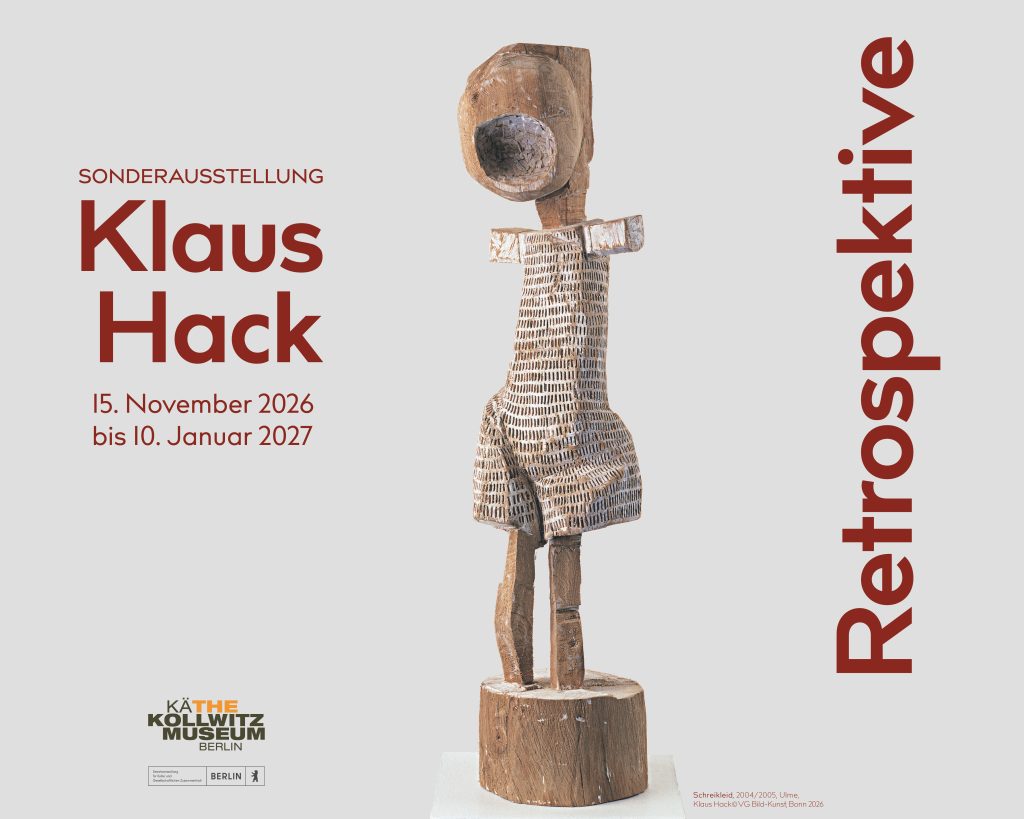
Klaus Hack – Retrospective
November 15, 2026 to January 10, 2027
Opening: Sunday, November 15, 2026, 11:00
Klaus Hack (born in Bayreuth in 1966) is an artist who not only embarked on his independent career early on and with great success, but has also continuously developed his work ever since. Bucking the trends of his time, Hack—inspired by Expressionist sculptures—chose wood as his medium from the very beginning. For 40 years now, he has been creating large-format, often white-painted wooden sculptures using this material—works that demonstrate versatile and virtuosic craftsmanship, imaginative motifs, and multifaceted themes.
After completing an apprenticeship as a carpenter, Klaus Hack first studied at the Academy in Nuremberg under the figurative sculptor Wilhelm Uhlig (1930–2022). In 1991, he transferred to the Berlin University of the Arts to study under Rolf Szymanski (1928–2013), where he began to move away from the intact human figure, allowing bodies and objects to develop into free forms. The artist has been working independently since 1995.
Klaus Hack’s sculptures are mostly viewable from all sides, full of openings and intertwined forms. The artist invents fantastical creatures, obsessively structured surfaces, and architectural forms, and constructs altars of unusual spirituality. His woodcut prints combine two- and three-dimensional elements, with the carved tree trunk serving as a printing cylinder for large-format prints on canvas. In addition, Klaus Hack creates impressive woodcuts in high-contrast colors as well as delicately imaginative small-format paintings. The work of Klaus Hack, now sixty years old, is characterized by a love of storytelling and a wealth of imagination. In the consistency with which he has continually developed his work using wood as a medium, it stands as a singular phenomenon in the present day.
The exhibition traces the artist’s creative development from his early beginnings in the mid-1980s—which were influenced by the sculptures of Ernst Ludwig Kirchner (1880–1938), through his work as a master student under Rolf Szymanski and his first independent works—the large-format print drum pieces—to the internalized seated figures of the early 2000s, the architectural objects and reliefs, and up to his current altars and figures.
On display are approximately 30 sculptures—some of them large-scale—along with several monumental woodblock prints and woodcuts, as well as numerous drawings.