
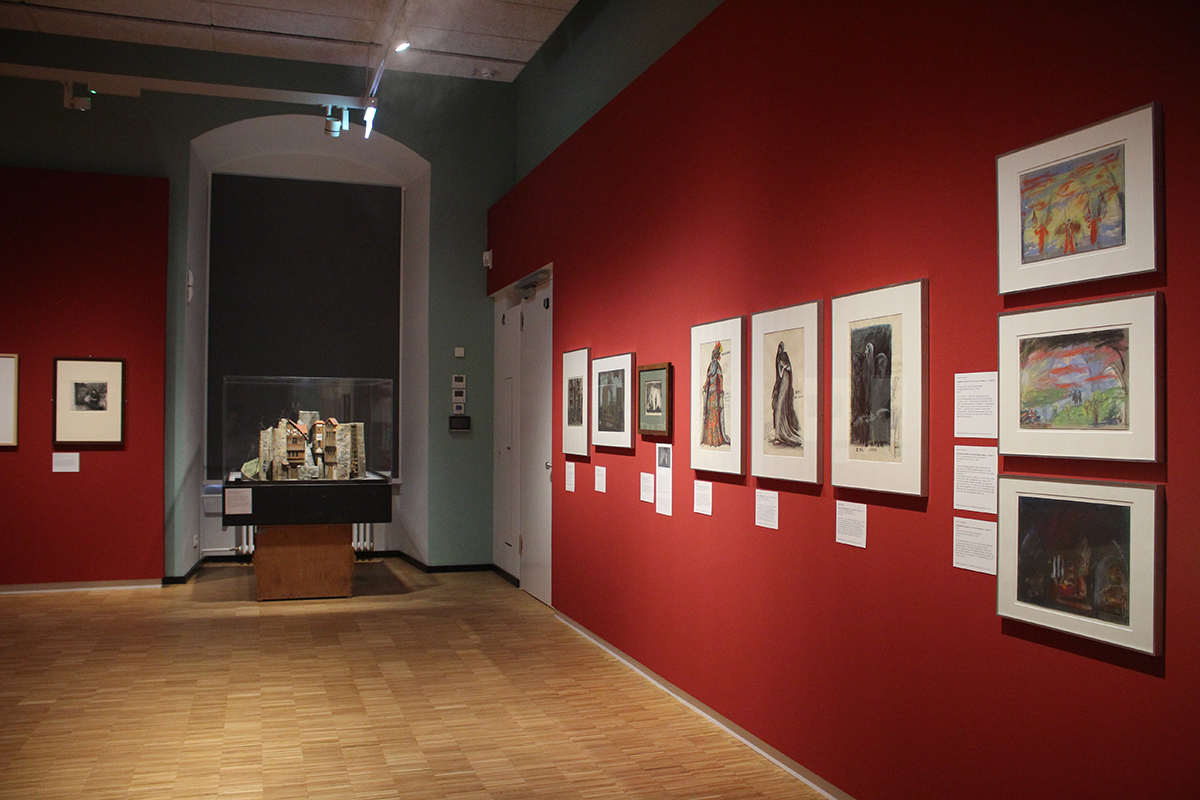
Kollwitz’s first documented visit to a Berlin theatre dates back to February 26, 1893. It was the premiere of “The Weavers” by Gerhart Hauptmann (1862–1946), which made a profound impression on her. She later recalled that she immediately began work on her own series of prints based on the play. However, she likely also responded to another drama that premiered only a few weeks later that same year: Max Halbe’s (1865–1944) “Jugend” (Youth).
Johann Wolfgang von Goethe (1749–1832) was the artist’s declared favorite poet, and his “Faust I” played a central role in the Kollwitz family’s Easter tradition. She had already engaged with the character of Gretchen in 1889, presumably while still studying in Munich. In 1897, she had the opportunity to see Parts I and II of the tragedy in Berlin. The only documented evidence, however, only confirms her attendance at Max Reinhardt’s (1873–1943) celebrated production of “Faust II” in 1911.
exhibited works:
4
Lovis Corinth
Portrait of Max Halbe
1917
Oil on canvas
Staatliche Museen zu Berlin, Nationalgalerie
The now almost forgotten author Max Halbe (1865–1944) is classified as a naturalist. He was still unknown when his drama “Jugend” (Youth) premiered on April 23, 1893, to sensational success. However, his subsequent stage works were unable to build on this success.
5
Käthe Kollwitz
Young Couple
1904?
Etching, line etching, emery, reverse etching, and vernis mou with fabric printing
Käthe Kollwitz Museum Berlin
The subject of the 1893 etching clearly remained close to Käthe Kollwitz’s heart, as she revisited it after 1900. It is possible that she was dissatisfied with the technical execution of the earlier version. In the later print, the artist employed more complex intaglio techniques.
6
Käthe Kollwitz
Full-length self-portrait, seated
1893
Pen and ink, washed on handmade paper
Käthe Kollwitz Museum Cologne
Like many young artists, Käthe Kollwitz liked to use herself as a model, studying her posture and the effect of her facial expressions and gestures in front of a mirror. However, this detailed study of the female figure in the 1893 etching also has a personal touch. Kollwitz is said to have told her friend, the painter Otto Nagel (1894–1967), that the work was created after her first marital dispute with her husband Karl.
7
Käthe Kollwitz
Young Couple
1893
Etching, aquatint, emery, and polished steel on vellum, reworked with opaque white
Staatliche Museen zu Berlin, Kupferstichkabinett
This early etching can only be indirectly linked to Max Halbes’ (1865–1944) romantic drama Jugend (Youth), which premiered in 1893. Käthe Kollwitz herself must have told this to the Berlin art historian Johannes Sievers (1880–1969), who published it in his 1913 catalogue raisonné of her graphic works.
8
Alfred Roller (design)
Revolving stage model for Goethe’s “Faust I”
1909
(Production by Max Reinhardt at the Deutsche Theater Berlin, 1909)
Theater Studies Collection of the University of Cologne
In March 1909, Max Reinhardt (1873–1943) staged Goethe’s “Faust. Part I” using a revolving stage, which was a novelty at the time. Whereas the setting had previously been depicted using painted backdrops, the play was now performed in three-dimensional spaces. Reinhardt had first used the revolving stage in Berlin in 1905.
The director liked to commission visual artists to design the stage and costumes. In this case, it was Alfred Roller (1864–1935), co-founder of the Vienna Secession and an experienced stage designer.
9
Alfred Roller
Set design for Faust I (Street)
1909
(Staged by Max Reinhardt at the Deutsches Theater Berlin, 1909)
Mixed media
Theater Studies Collection of the University of Cologne
With his design, Alfred Roller (1864–1935) envisioned a single setting on the street for the revolving stage. Three scenes from the tragic plot take place on this street:
– Faust encounters the innocent Gretchen for the first time and woos her.
– A confrontation ensues between Faust and Mephisto.
– In a dispute between Gretchen’s brother Valentin and Faust, Faust kills the brother.
10
Emil Orlik
Rehearsal at Reinhardt’s
1909
Charcoal, colored chalk
Theater Studies Collection of the University of Cologne
The artist drew this sketch in 1909 during a rehearsal for Max Reinhardt’s (1873–1943) production of the tragedy “Faust. Part I.”
11
Emil Orlik
Max Reinhardt at the dress rehearsal with Paul Wegener as Mephisto
1911
(Production of “Faust II” by Max Reinhardt at the Deutsche Theater Berlin, 1911)
Etching
Private collection, Berlin
On Easter Monday 1911, Käthe and Karl Kollwitz attended Max Reinhardt’s (1873–1943) production of Goethe’s “Faust. Part II,” which lasted eight hours. Both wrote about it to their son Hans, who was studying away from home.
12
Ernst Stern
Figurine (costume design) for Faust as Plutus
1911
(Production of “Faust II” by Max Reinhardt at the Deutsche Theater Berlin, 1911)
Mixed media
Theater Studies Collection of the University of Cologne
On April 18, 1911, Käthe Kollwitz wrote to her son Hans about the performance, in which she was particularly impressed by the Mummenschanz scene in the first act with the procession of various groups of costumed people. Here, Faust appears in the costume of Plutus, the personification of wealth and mineral resources. The artist found: “The masked ball was splendid.”
13
Ernst Stern
Figurine (costume design) for Sorge in “Faust II”
1911
(Production by Max Reinhardt at the Deutsche Theater Berlin, 1911)
Mixed media
Theater Studies Collection of the University of Cologne
Another scene, which the artist described to her son Hans in 1911 as “delicate and captivating,” revolves around Faust’s purification in the final act, which redeems him from his pact with the devil. To this end, he is approached by the “Four Gray Women,” the personifications of want, need, guilt, and worry. But only worry, which Kollwitz also mentions separately, succeeds in touching Faust’s innermost being and bringing him to his senses.
14
Ernst Stern
Figurine (costume design) for the siren in “Faust II”
1911
(Production by Max Reinhardt at the Deutsche Theater Berlin, 1911)
Mixed media
Theater Studies Collection of the University of Cologne
In the second act of the tragedy, Faust is transported to the ancient world with its gods and heroes. Sirens also appear here. These are bird-like female mythical creatures who, in mythology, beguile sailors with their singing in order to lead them to their doom. The costume design is supplemented by a construction sketch that visualizes the stage realization of this mythical creature.
15
Lovis Corinth
Stage design for the prologue in heaven in “Faust I”
1922
(Production by Victor Barnowsky at the Lessingtheater Berlin, 1922)
Pastel
Theater Studies Collection of the University of Cologne
Lovis Corinth (1858–1925) was commissioned in 1922 to create the stage design for Victor Barnowsky’s (1875–1952) production of “Faust. Part I” at the Lessingtheater. He developed his overall concept from the scene of the prologue in heaven, in which the three archangels glorify God’s works. The outline of a Gothic vault for later scenes already appears in the heavenly scene.
16
Lovis Corinth
Stage design for the Easter walk in Faust I
1922
(Production by Victor Barnowsky at the Lessingtheater Berlin, 1922)
Pastel
Theater Studies Collection of the University of Cologne
Behind the vaulted sky of the prologue, the setting for Faust and his assistant Wagner’s Easter walk outside the city gates can be seen.
In the Kollwitz family, it was part of the annual Easter ritual to read aloud from the text of Faust, Part I. It therefore seems plausible that the artist had seen more than one production of the play. In this case, her esteemed colleague Corinth was also involved in the production at the Lessingtheater.
17
Lovis Corinth
Stage design for the study in “Faust I”
1922
(Production by Victor Barnowsky at the Lessingtheater Berlin, 1922)
Pastel
Theater Studies Collection of the University of Cologne
In this design, the Gothic vault, which is outlined in the other stage designs, now comes to the fore. Here it becomes the study of the scholar Faust in the first act. However, with a different interior, it can also serve as the architecture for the scenes in Auerbach’s Cellar and in the cathedral.
1
Käthe Kollwitz
March Cemetery
1913
Crayon lithograph
with typographic text at the bottom: 18 MARCH / FOR THE MEMBERS OF THE FREIE VOLKSBÜHNEN
Ute Kahl Collection, Cologne
In 1913, Käthe Kollwitz had an edition of this lithograph printed for the members of the Verein Volksbühne (People’s Theater Associations) at a low price. This was probably intended to enable them to purchase art. It is conceivable that the campaign was also linked to the collection of funds for the construction of their own theater, the Volksbühne (People’s Theater), which opened in 1914 on what is now Rosa-Luxemburg-Platz in Berlin.
2
Käthe Kollwitz
March Cemetery
1913
Charcoal on Ingres laid paper
Ute Kahl Collection, Cologne
This drawing was used to prepare the lithograph of the same name, which commemorated March 18, 1848. On that day, 300 protesters fell victim to royal troops in Berlin during the revolutionary events of 1848/49. The rebels’ goals were national unity and political freedom in Germany. SPD circles commemorated these dead every year on March 18.
3
Käthe Kollwitz
Cover design for the Freie Volksbühne association magazine
circa 1900
Graphite and pen in black ink
Käthe Kollwitz Museum Cologne
The Freie Volksbühne association was founded in 1890 to give workers access to the theater. Closed events also allowed plays that were subject to censorship to be performed. Käthe Kollwitz’s brother Conrad Schmidt (1863–1932) was involved in the founding of the association and became its chairman in 1897. It was probably at his instigation that his sister created the vignette for the cover of the association’s magazines.
brief introduction to the authors:
Lovis Corinth
(Tapiau 1858 – 1925 Zandvoort)
Corinth received his artistic training in Königsberg, Munich, and Paris. After initial successes in Munich, he moved to Berlin in 1900 and joined the Secession. Coming from Impressionism, Corinth developed his paintings with vigorous brushwork and increasing colorfulness. He focused on mythological and religious themes, and was also an outstanding portraitist.
Emil Orlik
(Prag 1870–1932 Berlin)
After studying in Munich and working independently in Prague, Orlik was appointed head of the graphic arts class at the Berlin School of Arts and Crafts in 1905. He was a member of the Berlin Secession and made a name for himself as a portraitist of numerous figures from the performing and visual arts. Orlik also created designs for stage sets and costumes. He undertook numerous long-distance journeys and was inspired by Japanese woodblock prints.
Alfred Roller
(Brünn 1864–1935 Wien)
Born into a family of artists, Alfred Roller studied at the Vienna Academy and became a co-founder of the Vienna Secession in 1897. Until 1903, he worked as a teacher at the School of Applied Arts, then moved to the Vienna State Opera as head of set design, where he established the idea of the scenic Gesamtkunstwerk (complete work of art) together with Gustav Mahler. In 1909, Roller became director of the School of Applied Arts in Vienna, at the same time beginning his long-standing collaboration with Max Reinhardt in Berlin.
Ernst Stern
(Bukarest 1876–1954 London)
After studying at the Munich Art Academy, Stern initially worked as an illustrator for the well-known magazines “Jugend” and “Simplicissimus”. In 1905, Stern moved to Berlin and became a member of the Secession. He quickly rose to become chief set designer at the Reinhardt Theatres, and in the 1920s designed sets for operas, revues, and films. Stern continued to work as a visual artist and created several portfolios of prints. After 1933, Stern emigrated to London.
plays in brief:
Youth
Max Halbe’s drama “Jugend” (Youth) depicts the forbidden love between Annchen and her cousin Hans at a West Prussian parsonage. Caught between family expectations, social morals, and religious norms, their relationship escalates into conflict and tragic consequences. When a jealous rival exacerbates the conflict, a violent incident with fatal outcome ensues.
Faust I
The scholar Faust, despairing at the limits of his knowledge and life, enters into a pact with Mephisto, the devilish seducer: he receives youth and worldly fulfillment in exchange for his soul. On his travels, he meets a young girl named Gretchen and begins a passionate relationship. Faust’s actions throw her life into turmoil: her mother and brother die, Gretchen despairs, kills her child, and is imprisoned. Faust flees with Mephisto—Gretchen is left behind.
Faust II
In “Faust II”, Faust awakens at an imperial court, where, with Mephisto’s help, he promises wealth and order. On a journey through ancient and mythical worlds, he encounters Helen of Troy and experiences love and loss with her. In his old age, Faust wrestles land from the sea and pursues a major construction project. Blind and close to death, he dies at the moment of completion. Mephisto demands his soul, but angels take it away from him.