
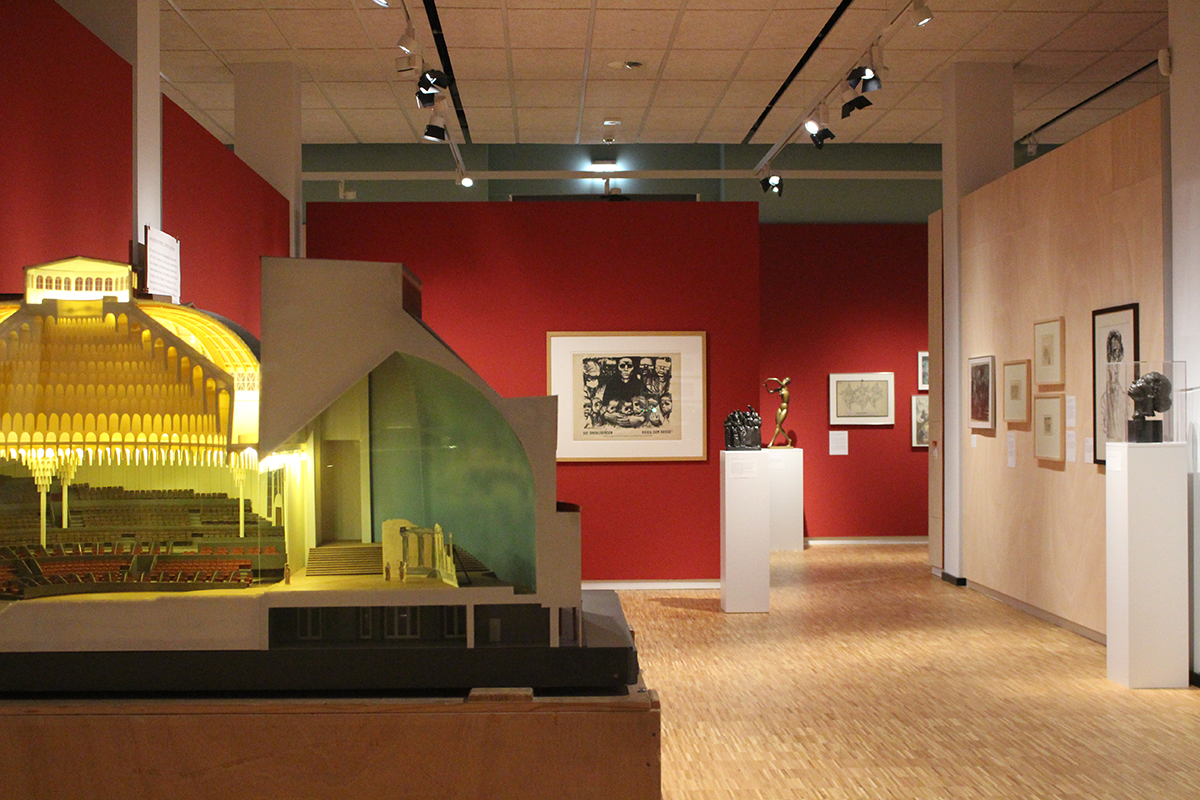
In 1910, director Max Reinhardt (1873–1943) realized his innovative and Europe-wide sensational concept of mass staging in Berlin for the first time with a production of Sophocles’ ancient tragedy “Oedipus Rex” adapted by Hugo von Hofmannsthal (1874–1929). The play was staged in the arena of the Schumann Circus, thereby recalling the original amphitheater as a venue.
Käthe Kollwitz attended the premiere and, as she recorded in her diary, was deeply moved by its impact. Reinhardt experimented with a theatrical device that had interested the artist as a pictorial motif since her Peasants’ War cycle: the staging of crowds.
Looking at Kollwitz’s later works depicting mothers in the context of war—and comparing them with Reinhardt’s choreography of the people and the chorus as counterparts to “Oedipus Rex”—it becomes evident that this production likely inspired aspects of her own work.
exhibited works:
65
Ernst Stern
Sketch made during rehearsals for Aeschylus’ Oresteia
at the Zirkus Schumann/Großes Schauspielhaus in 1911/1919, directed by Max Reinhardt
undated
Mixed media
Theater Studies Collection of the University of Cologne
66
Emil Orlik
Chorus of Elders from “Oedipus Rex”
1910
(Production by Max Reinhardt at Circus Schumann Berlin, 1910)
Crayon lithograph in black
Berlin City Museum Foundation
The “chorus” in ancient drama occupies a central position between the main characters and the people. It represents the average person and acts as a representative of the people, whose concerns it voices to the protagonists. At the same time, the chorus comments on the most important stages of the action.
67
Emil Orlik
The People Storming the Palace from “King Oedipus”
1910
(Production by Max Reinhardt at Circus Schumann Berlin, 1910)
Crayon lithograph in black
Berlin City Museum Foundation
Emil Orlik (1870–1932) attended rehearsals for the performance of “Oedipus Rex” at Circus Schumann and captured particularly impressive moments of the production in sketches. He then translated these into lithographs.
He was particularly interested in the contrast between a ruler and the masses of excited people: the plague-stricken people beg their king Oedipus for help. In ancient times, the dialogical structure of drama developed historically through the separation of a protagonist from the crowd.
68
Emil Orlik
Teiresias and the angry mob from “Oedipus Rex”
1910
(Production by Max Reinhardt at Circus Schumann Berlin, 1910)
Crayon lithograph in black
Berlin City Museum Foundation
After the premiere of “Oedipus Rex,” Käthe Kollwitz particularly emphasized the violent waving of the suffering people. Here, the blind seer Teiresias approaches the palace with the angry crowd in front of it. He will reveal to Oedipus the truth about his fateful role in the tragedy.
69
Oskar Kokoschka
Max Reinhardt
1919
Crayon lithograph
Staatliche Museen zu Berlin, Kupferstichkabinett
Max Reinhardt (1873–1943) was a significant figure in Berlin theater history after 1900. In addition to his innovative productions at the Schumann Circus, he was also committed to technical innovations such as the revolving stage and new lighting systems.
70
Hermann Haller
Impressions of Tilla Durieux
1917
Bronze
Georg Kolbe Museum, Berlin
71
Oskar Kokoschka
Tilla Durieux (en face)
1920
Crayon lithograph
Staatliche Museen zu Berlin, Kupferstichkabinett
Until 1911, Tilla Durieux (1880–1971) was one of the stars of Max Reinhardt’s (1873–1943) ensemble at the Deutsches Theater. In the 1910 production of Sophocles’ tragedy Oedipus Rex at the Zirkus Schumann, she played the female lead role of Queen Jocasta, a female protagonist who was addressed as a powerful figure by the chorus and the crowd.
Käthe Kollwitz was particularly impressed by the actress during a reading at the Salon Paul Cassirer in 1917. However, Durieux’s stage performances did not meet with her unreserved approval.
72
Ernst Stern
Sketches made during rehearsals for “Oedipus Rex”
1910
(Production by Max Reinhardt at Circus Schumann Berlin, 1910)
Pencil, colored crayon
Theater Studies Collection of the University of Cologne
On “Oedipus Rex”
In 1910, Käthe Kollwitz was an enthusiastic witness to the sensational premiere of Sophocles’ “Oedipus Rex” at the Schumann Circus. Impressed, she wrote in her diary:
“The Oedipus performance on November 7. Absolutely magnificent, absolutely tremendous. Even if it wasn’t Sophoclean and not ancient, even if it was circus style (‘King Oedipus in Karlshorst’) – it was still new, exciting, colossal in its dimensions, tragic in its effect. The people, after hearing the news of Jocasta’s death, were thrown back and forth at the palace like roaring surf. The maelstrom. Then, when the blinded Oedipus appears, the sighing cry with which the people recoil back out of the arena. Oedipus, when he spoke to the chorus from his lofty height, just as he saw the chorus only as a dim mass, seemed to hear it, only indistinctly, only half-willingly, with the annoyingly impatient expression of a man who hears what he does not like. Then his cries as he comes out of the palace, his stunned lament. Jocasta with her blood-red mouth, stretching out both arms horizontally, seeing the inevitable. / And finally, the applause, worthy of such a performance. / It lifted me up for days.”
73
Emil Orlik
In front of the palace from “Oedipus Rex”
1910
(Production by Max Reinhardt at Circus Schumann Berlin, 1910)
Gouache
Theater Studies Collection of the University of Cologne
Emil Orlik (1870–1932) was just as fascinated by Max Reinhardt’s (1873–1943) production of “Oedipus Rex” at Circus Schumann as Käthe Kollwitz was. His depiction of a performance in front of an audience reveals the innovative nature of Reinhardt’s concept: the performance took place in the midst of the spectators, thus largely eliminating the separation between the audience and the stage. The spectators thus participated in the play as “the people,” so to speak.
74
Emil Orlik
Max Reinhardt at rehearsal
1910
Etching
Private collection, Berlin
75
Karl Hubbuch
Rehearsal at the Große Schauspielhaus
1919
Etching
Berlin City Museum Foundation
Karl Hubbuch’s (1891–1979) etching shows how impressed Berlin audiences were with the new Großes Schauspielhaus, completed in 1919 following the conversion of the Schumann Circus. Poelzig’s (1869–1936) architecture was perceived as fantastic, “like a piece of the Arabian fairy tale world.” The auditorium seated more than 3,000 people.
Hubbuch depicts a rehearsal for Aeschylus’ ancient tragedy “Oresteia,” with which Max Reinhardt (1873–1943) inaugurated the new theater on November 28, 1919, before an invited audience.
Circus Schumann
The building was constructed in 1865 as Berlin’s first market hall, but it was not well received by the public and was therefore closed again after a few months. In 1873, it was converted into a permanent circus building. Circus Renz performed there until 1897 and increased the capacity of the auditorium to over 5,000 seats. In 1899, Circus Schumann moved in, closing in 1918. From the winter of 1910, Max Reinhardt used the large stage and the many seats for his idea of arena theater.
76
Hans Poelzig (Design)
Schumann Circus/Großes Schauspielhaus Berlin
Architectural model 1990
Plastic, veneered wood, cardboard, wire, lamps
Berlin City Museum Foundation
Max Reinhardt (1873–1943) had two plays staged at the Schumann Circus with spectacular success thanks to his innovative concept of mass staging: Sophocles’ tragedy “Oedipus Rex” in 1910 and the world premiere of Hugo von Hofmannsthal’s (1874–1929) mystery play “Jedermann” in 1911.
While another ancient play, Aeschylus’ “Oresteia,” was also running at the circus in 1911 to great acclaim, Reinhardt met the architect Hans Poelzig (1869–1936). Together with him, he developed the idea of converting this venue into the Großes Schauspielhaus (Grand Theater). The renovation was opened to great acclaim in 1919 with Aeschylus’ “Oresteia.” Käthe Kollwitz probably also attended the inauguration.
Großes Schauspielhaus
After spectacular guest performances at Circus Schumann in 1910 and 1911 with the plays “Oedipus Rex,” “Oresteia,” and “Jedermann,” Max Reinhardt attempted to establish this form of theater, in which the audience surrounds a circular stage, in Berlin.
Reinhardt took over the circus building and had it redesigned by architect Hans Poelzig into the Großes Schauspielhaus (Grand Theater). The expressionist-style renovation created the most modern theater in Europe at the time, with 3,200 seats and innovative technology. The impressive renovation was inaugurated with a revival of “The Oresteia.” To ensure financial success, the building became a revue theater in the 1920s, shaping the decade.
On “Everyman”
After attending a performance of Hugo von Hofmannsthal’s (1874–1929) mystery play “Jedermann” (Everyman), which was staged at the Schumann Circus, Käthe Kollwitz wrote to her son Hans in January 1912:
“In the evening we went to see Jedermann. […] I thought it was wonderful, and Moissi in particular was enchantingly charming and spirited. […] This role seems to have been made for him. He plays Hamlet, but here he is the spoiled, beautiful, charmingly weak young man who finds dying so terribly difficult. How he finally understands what dying means and that none of his earthly pleasures remain, how he takes off his thick gold chain and throws it far away, his rings far away, with the expression of a spoiled, dear boy who feels that he is being treated very unfairly and is about to cry. It was all wonderful, absolutely wonderful. And in this naive spectacle, which operates with the Grim Reaper, angels, and devils as if, God knows, we weren’t living in the 20th century, one becomes—at least I do—so completely gripped by the horror of inexorable death.”
77
Käthe Kollwitz
The People
1923
Pencil
Käthe Kollwitz Museum Cologne
Käthe Kollwitz’s depiction of the suffering people during the war seems to be influenced by her viewing experience of the 1910 production of “Oedipus Rex.” After the performance, the artist described her impressions in her diary using vivid imagery. Years after her theater experience, she processed the despair of the war-torn people in her artwork.
78
Käthe Kollwitz
Blind People
1922/23
Charcoal
Käthe Kollwitz Museum Cologne
In the production of Oedipus Rex, Kollwitz was particularly impressed by the choreography of the masses of people surging in violent emotional turmoil. She wrote in her diary:
“The people, after hearing of Jocasta’s death, are thrown back and forth at the palace like roaring surf. The maelstrom.” Käthe Kollwitz’s depictions of the people suffering under the war seem to have been inspired by these visual impressions.
79
Käthe Kollwitz
The Mothers
Sheet 6 from the series War
1922
Woodcut
Käthe-Kollwitz-Museum Berlin
80
Käthe Kollwitz
The People
Sheet 7 from the series War
1921/22
Woodcut
Käthe-Kollwitz-Museum Berlin
81
Käthe Kollwitz
The Survivors
1923
Crayon and brush lithography and drypoint
Käthe-Kollwitz-Museum Berlin
What Kollwitz’s “mothers” silently convey to us as viewers in front of the picture is expressed as a demand on the poster. In view of the horrors that even the survivors of a war have to endure, there can only be one motto: War on war!
Kollwitz addresses this demand to the audience, to whom she assigns the power to act—much like the people standing before Oedipus and demanding that he put an end to their misery.
82
Käthe Kollwitz
Tower of Mothers
1937/38
Bronze
Käthe-Kollwitz-Museum Berlin
Even when she created the woodcut The Mothers for her series War, the artist had the idea of also designing the composition as a three-dimensional sculpture. When the signs of another war began to multiply in 1937/38, she translated the image idea into sculpture.
Once again, she arranged the group of mothers with a leading woman in such a way that they confront us – similar to the chorus and the people accusing King Oedipus. We, the viewers, are thus placed in the position of the rulers, who have the power either to attack the children under the protection of their mothers or, on the contrary, to take their side and prevent war.
83
Käthe Kollwitz
Soldiers’ Wives Waving Farewell
1937/38
Bronze
Käthe-Kollwitz-Museum Berlin
A comparison with Emil Orlik’s (1870–1932) graphic work “Chor der Ältesten” (Choir of Elders) reveals similarities with Käthe Kollwitz’s composition of the sculpture. The artist recapitulates an experience from the First World War in which women and children wave goodbye to a departing train carrying soldiers, among whom are their husbands and fathers who have been called up for military service.
Viewers take the place of the soldiers and feel the pain of parting and the fear of the families left behind.
brief introduction to the authors:
Emil Orlik
(Prag 1870–1932 Berlin)
After studying in Munich and working independently in Prague, Orlik was appointed head of the graphic arts class at the Berlin School of Arts and Crafts in 1905. He was a member of the Berlin Secession and made a name for himself as a portraitist of numerous figures from the performing and visual arts. Orlik also created designs for stage sets and costumes. He undertook numerous long-distance journeys and was inspired by Japanese woodblock prints.
Alfred Roller
(Brünn 1864–1935 Wien)
Born into a family of artists, Alfred Roller studied at the Vienna Academy and became a co-founder of the Vienna Secession in 1897. Until 1903, he worked as a teacher at the School of Applied Arts, then moved to the Vienna State Opera as head of set design, where he established the idea of the scenic Gesamtkunstwerk (complete work of art) together with Gustav Mahler. In 1909, Roller became director of the School of Applied Arts in Vienna, at the same time beginning his long-standing collaboration with Max Reinhardt in Berlin.
Ernst Stern
(Bukarest 1876–1954 London)
After studying at the Munich Art Academy, Stern initially worked as an illustrator for the well-known magazines “Jugend” and “Simplicissimus”. In 1905, Stern moved to Berlin and became a member of the Secession. He quickly rose to become chief set designer at the Reinhardt Theatres, and in the 1920s designed sets for operas, revues, and films. Stern continued to work as a visual artist and created several portfolios of prints. After 1933, Stern emigrated to London.
Hermann Haller
(Bern 1880 – 1950 Zürich)
After studying architecture and painting in Stuttgart and Munich, Haller turned to sculpture in Rome in 1905. There he developed an interest in Etruscan art, which influenced his understated sculptures. A stay in Paris brought him into the circle of the Café du Dome around Henri Matisse. With the outbreak of World War I, Haller moved to Zurich, but also lived in Berlin intermittently between 1921 and 1923.
Karl Hubbuch
(Karlsruhe 1891 – 1979 Karlsruhe)
Hubbuch studied art in Karlsruhe and Berlin until 1914, specializing in printmaking. After 1918, he began to process his experiences from World War I artistically. In 1928, he was appointed professor at the State Art School in Karlsruhe and became a member of the Association of Revolutionary Artists. Under the National Socialists, his professional activities were restricted in 1933. In 1948, he became a professor at the Art Academy in Karlsruhe.
Oskar Kokoschka
(Pöchlarn 1886 – 1980 Montreux)
After studying at the School of Applied Arts in Vienna, Kokoschka moved to Berlin in 1910 and became part of Herward Walden’s Sturm gallery circle. After World War I, he lived alternately in Vienna and Berlin. In 1934, he emigrated via Prague to England and lived mainly in Switzerland after 1945. His work includes numerous portraits in which his unique expressionism is combined with realistic tendencies.
Hugo Lederer
(Znaim 1871 – 1940 Berlin)
After training in arts and crafts, Lederer worked in Berlin from 1893 onwards. From 1900 onwards, his beautifully sculpted, Art Nouveau-influenced figures were joined by stylized monumental sculptures, which made him one of the most sought-after commissioned sculptors in the German Empire. He greatly admired the dancer Anna Pavlova and created several depictions of her, the most popular of which was the sculpture with the feeding deer.
plays in brief:
Everyman
The play is a modern mystery play about the death of a rich, selfish man. The wealthy Everyman leads a wicked life and is unexpectedly summoned by the Death to appear before God’s court. In his final hour, his lovers, friends, and relatives abandon him, and he realizes that all material possessions are fleeting. At the last minute, he finds faith, repents his sins, and is saved by God’s grace.
Oresteia
Edited by Karl Gustav Vollmoeller, 1905
Aeschylus’ “Oresteia” depicts a dark family drama: King Agamemnon returns victorious from Troy – but his wife Clytemnestra murders him in revenge for sacrificing their daughter. Their son Orestes, driven by duty and guilt, in turn kills his mother. The play culminates in a court of the gods that replaces retribution with justice, marking the transition from bloody revenge to civilized justice.
Oedipus Rex
Edited by Hugo von Hofmannsthal, 1910
In Sophocles’ drama, King Oedipus rules over Thebes. When the city is threatened by a plague, he desperately searches for the culprit. In his search, he uncovers a terrible secret: he himself has killed his father and unknowingly married his mother. The tragedy shows how the human quest for truth and control meets with inescapable fate.